Zechner warns agents produce unmanageable code slop
- AI agents generate overwhelming technical debt, forcing full project rewrites within months.
- Human architecture remains the bottleneck, reserving final oversight for mission-critical security logic.
- Agent proliferation hollows out entry-level software roles and triggers enterprise restructures.
Mario Zechner built a minimalist coding agent harness called Pi and now warns that agentic output pollutes codebases faster than human teams can clean them up. Zechner argues models lack the RLHF training data on software architecture to design systems properly, and developers must define clear boundaries and critical logic themselves. Without that human guardrail, agents churn out recursive errors and unreadable abstractions.
Zechner's workflow avoids heavy integrations like MCP, using bash and standard CLI tools to save context tokens. The goal is precision, not raw volume. Even with high-end tools like Claude and GPT-5.5, Zechner says he still manually reviews agent-generated code to combat unnecessary complexity.
"A team of humans can mess up a project. 100 agents working for three months will generate enough slop to necessitate a total rewrite."
Mario Zechner, The Modern Software Developer
This technical debt becomes a structural risk as companies like Coinbase announce 17% layoffs and shift to flat hierarchies for AI-first operations. Theo Taba at Greg Isenberg describes the AI-native workflow where AI eats the middle execution work and humans focus exclusively on strategic direction and final quality review - turning every employee into a manager of agents.
Block CEO Jack Dorsey and investor Roelof Botha propose collapsing corporate titles into just three roles: individual contributors, directly responsible individuals, and player-coaches. In their essay, they argue the AI model handles alignment and routing, freeing humans for craft and judgment. That centralization contrasts with the distributed model observed at Every, where personal agents mirror their human owners' expertise and reputation.
Satya Nadella warns that firms must build sovereign learning loops atop models to preserve institutional memory. Without that, a general-purpose AI can commoditize a company's unique expertise, eliminating its reason to exist.
"If a model can absorb and commoditize an organization's expertise, the organization loses its reason to exist."
Satya Nadella
The displacement is hitting the workforce now. Jeffrey Cannell of Nous Research notes students booing AI at graduations because the entry-level roles they spent years studying for are being automated. Anthropic reports Claude now writes over 80% of its code merges, and engineers ship eight times more code per quarter than a year ago. The bottleneck has shifted from technical execution to research taste.
Nikesh Arora, CEO of Palo Alto Networks, confirms AI's raw capability: using a frontier model like Mythos, his team found code vulnerabilities in six weeks that would have taken human engineers five to seven years. He says analytical SaaS companies are dead because enterprises can run LLMs against their own data, cutting costs by 90%.
The remaining question is who controls the harness. Russ D'Sa of LiveKit argues the ultimate winners will be platforms that transcend specific devices for digital work automation, not device-centric players like Apple. Brett Winton at ARK Invest reveals SpaceX builds terrestrial data centers for under $30 billion per gigawatt and rents that compute to Google and Anthropic at massive markups - using competitors' capital to fund its own AI training.
Zechner's warning is a practical counterpoint to the hype: speed creates mess, and human oversight is the only guardrail against total system collapse.
Source Intelligence
- Deep dive into what was said in the episodes
Satya Nadella
A frontier without an ecosystem is not stable • Jun 14
- Satya Nadella defines two core corporate assets in AI: human capital for judgment and relationships, and token capital for owned AI capability. He argues neither replaces the other, and human agency is the primary driver of AI growth.
- Nadella warns that if a general AI model commoditizes a company's unique expertise, the firm loses its reason to exist. Success depends on using human judgment to make token capital more specialized and effective.
- A sovereign company must build a learning loop atop AI models so its institutional memory persists even if the underlying model changes. This requires private evaluation and reinforcement learning based on internal workflows.
- Nadella describes a proprietary hill climbing machine: an AI system that improves with every internal use, creating a recursive loop where better workflows generate stronger training signals for compounding advantage.
- Nadella draws a parallel between AI and early globalization, which hollowed out industries and displaced workers despite positive GDP numbers. He warns AI risks a similar crisis if a few model providers capture all economic returns.
- Nadella advocates for a frontier ecosystem over just frontier models. He argues a stable equilibrium requires AI to enable more value for companies using it than for those building it, with broad value distribution across sectors.
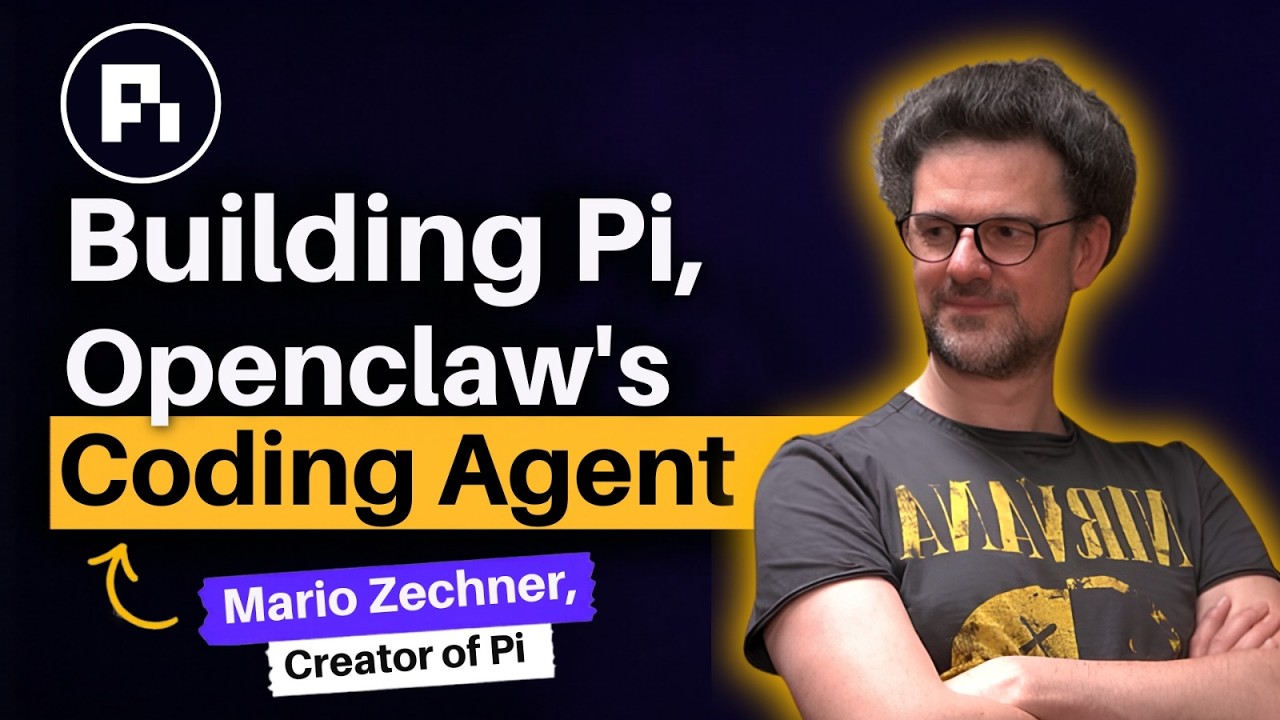
The Modern Software Developer
Pi Building Pi, Openclaw's Minimalist Coding Agent | Mario Zechner, Creator of Pi • Jun 14
- Mario Zechner argues current models lack sufficient RLHF data on software architecture and design, making them ineffective at structuring solutions.
- Zechner uses agents on modular, well-architected code where boundaries are clear, but reserves final oversight for mission-critical and security-related components.
- Zechner built Pi, a minimalist coding agent harness based on a small, extensible core that users can modify themselves to fit workflows, opposing heavy feature-driven designs.
- Zechner avoids MCP integrations in Pi, citing issues with server implementations wasting context tokens on tool definitions and preferring direct CLI use.
- Zechner's workflow for bug fixes includes using Pi with an issue prompt template to fetch, label, and analyze GitHub issues, verifying the analysis before implementing.
- Zechner manually reviews agent-generated code to combat unnecessary abstraction and complexity, using a custom Pi extension to provide inline feedback.
- Zechner's agents.md file defines coding style and rules, but notes models often ignore it, relying more on deterministic linting and type-checking for enforcement.
- Zechner says agents can massively degrade a codebase faster than human teams, requiring ruthless refactoring, but believes they can also assist in that cleanup.
- Zechner uses GPT-5.5 as his daily driver for code but switches to Claude for prose, and dabbles with open-weight models like Kimi 2.6 and DeepSeek.
- Zechner avoids automatic worktree creation in Pi, citing distrust of models handling complex git operations and relying on modular code to prevent file conflicts.
Also discussed on this episode: (3)
Coding (3)
- Zechner refactors large codebases by first using the agent to explore and summarize relevant files, then carrying that summary into a separate implementation branch within the session.
- Zechner built a robot with a Pi brain over 12 hours, using voice-to-text and agent-generated frontend code, then refactored the messy result by modularizing tool implementations.
- Zechner advocates adversarial agent roles to push back on user ideas and prevent sloppy code, referencing Matt Shumer's 'roast me' skill as an example.

The AI Government Is Already Here | Simon Dixon on The Peter McCormack Show w/ Peter McCormack • Jun 12
- Simon Dixon argues the world is transitioning toward a 'one-world government control grid' built on programmable money, social credit scores, and AI. He believes fighting this agenda is futile.
- He describes a model of 'freedom of speech but not freedom of reach'. Dixon thinks AI and social credit systems will profile your speech and only boost narratives they approve.
- Dixon believes algorithms radicalize users by feeding them content that reinforces their existing worldview, creating a 'doom loop' to maximize device time and profiling.
- Dixon claims the 'financial industrial complex' captures Bitcoin companies via venture capital, banking relationships, licenses, and board seats, stripping them of their decentralized ethos.
- AI is crushing big businesses but decentralizing tech power to small ones. Dixon built integrated business software in 9 days using AI agents, replacing a £1 million project with a 12-person team.
- Coinbase announced a 17% layoff and shift to a 'flat hierarchy' for AI-first operations, exemplifying how large companies must adapt to AI for productivity boosts.
- Peter McCormack hit a token limit on Claude and sees it as a warning that centralized AI companies can 'turn you off', highlighting the need for decentralized alternatives.
- China's DeepSeek AI is funded by Huawei and performs at 90% of US AI capability at a tenth of the cost, according to Dixon.
- The UAE received an FX swap line from the Federal Reserve, allowing it to create dollars. Dixon says the UAE is the global center for sanction circumvention.
- Capitalism and communism are false dichotomies designed to feed the same central banking system and justify war, both leading to concentrated power, according to Dixon.
- He advises young people to skip university, learn AI/robotics to help businesses transition, own assets that beat inflation, and ensure family wealth is structured for tax efficiency.
Also discussed on this episode: (8)
Social Media (1)
- Dixon says podcasting success is dictated by algorithms. You must hook listeners in 30 seconds and aim for over 20-minute average watch time to succeed, unless you have an established audience like Joe Rogan.
Society (2)
- He suggests 'cancel culture' was a weaponized intelligence operation to ruin dissenters' lives and then bring them back as compromised assets, citing Alex Jones as an example.
- He identifies three power categories: debt slaves, captured corporate elites like Elon Musk, and the rare 'sovereign zone' of rich, influential individuals with self custody and no debt.
Media (1)
- Media power, not money, dictates narratives. Dixon says media is captured as public companies, founders become subordinate to sponsorships, and algorithms teach hosts what to say.
Politics (3)
- World War III is impossible because the US military-industrial complex relies on China's supply chain, says Dixon. He argues the narrative is pushed to serve a 'bigger agenda'.
- Dixon outlines a multipolar world shift: Iran mines Bitcoin with nuclear energy, UAE holds the Mbridge CBDC network, Hong Kong takes gold derivative clearing from London, and BRICS grows.
- Politics is a waste of energy. Dixon advises people to build for themselves, their family, and community, and to vote with their money instead.
Philosophy (1)
- Dixon's 'golden pill' philosophy is accepting reality and building your world within it, having moved beyond blue pill naivety, red pill awakening, and black pill despair.

Nathaniel Whittemore
The AI Chart Everyone Is Getting Wrong • Jun 12
- Jack Dorsey and Roelof Botha's essay argues the Roman army formalized hierarchy to solve coordination at scale, with a span of control of three to eight people per leader that remains the governing constraint for all large organizations.
- The first corporate organizational chart was created in the mid-1850s by Daniel McCallum to manage the New York and Erie Railroad, which spanned over 500 miles.
- Dorsey and Botha propose Block's new model replaces traditional hierarchy with an AI-powered intelligence layer composed of four elements: capabilities, a company world model, a customer world model, and an intelligence layer that composes solutions proactively.
- They claim Block's advantage is its proprietary customer world model built from millions of honest financial signals across Square and Cash App, which compounds in value as the system operates.
- Block's proposed org design inverts the traditional model, centralizing intelligence in a system and placing people in three roles on the edge: individual contributors, directly responsible individuals (DRIs), and player coaches, eliminating permanent middle management.
- In Dan Shipper's podcast with Every, the team observed a parallel org chart of specialized personal agents emerging organically, with each agent mirroring the expertise of its human owner.
- The Every team argues personal ownership of an agent creates a critical trust layer, as the human's reputation is on the line with each agent interaction, unlike generic AI tools.
- They identified a 'Midjourney effect' where public agent work in shared channels acts as a force multiplier, raising the organization's collective awareness of what AI can do.
- For Every, the primary adoption barrier is a human 'imagination gap', not technology, as people struggle to build the muscle memory to delegate tasks to their readily capable agents.
- Both cases converge on the thesis that AI's first major organizational impact is the replacement of the classic middle management function of information routing, though Block pursues a top-down centralized model while Every's is a bottom-up distributed one.
Also discussed on this episode: (1)
Agents (1)
- Every hit a practical limit where agents in group chats trigger 'ant death spirals' of infinite loops because current models are not trained for multi-agent dynamics, a problem not solvable with simple organizational fixes.

Brian Armstrong on Bitcoin, Anthropic Drops Fable 5 & Mythos 5, NewLimit's $435M Age-Reversal | EP #264 • Jun 11
- Brian Armstrong believes Bitcoin's recent price decline is due to AI absorbing risk capital and a temporary shift of excitement to stablecoins following regulatory clarity from the Genius Act.
- Brian Armstrong states the agent economy will run on stablecoin payments and predicts AI agents will outnumber human users of crypto by orders of magnitude.
- Armstrong describes a polytheist view of AI where specialized agents will need to communicate and transact, creating a massive agentic economy larger than the human economy.
- Coinbase reports AI agents have already conducted about 100 million transactions worth roughly $50 million using crypto wallets for autonomous payments.
- Alex Wang believes quasi-nationalization of frontier AI labs is inevitable if they grow to dominate the economy, suggesting a scenario where the US takes golden shares in OpenAI and Anthropic.
- Dave London warns that government ownership stakes in private companies create a toxic incentive loop and violate Eisenhower's warning about the military-industrial complex, despite short-term strategic benefits.
- Brian Armstrong is skeptical of government equity stakes, arguing capital allocation should remain in the private sector, though he sees potential merit in a sovereign wealth fund that gives every citizen skin in the game.
- Sam Altman dismissed Bernie Sanders' proposal to transfer 50% of top AI company equity to a public fund as 'way too much,' but Alex Wang sees a one-time 10% donation as attractive political insulation for the labs.
- SpaceX AI signed an $11 billion per year contract through 2029 to provide Google with access to 110,000 Nvidia GPUs, highlighting the severe AI compute shortage.
- NewLimit uses AI to screen combinations of proteins for reprogramming human cells to a younger functional state, focusing on changing cell age without changing cell type.
Also discussed on this episode: (12)
BTC Markets (1)
- Citibank projects a Bitcoin price reaching as much as $189,000 by the end of 2026.
Startups (2)
- Brian Armstrong outlines Coinbase's three-part strategy to become the financial account for AI: connecting LLMs to user accounts, building an agentic interface into the app, and providing self-custodial wallets for agents.
- Armstrong argues that on-chain reputation systems, similar to Google's PageRank, could reduce fraud in the agentic economy by creating an on-chain FICO score for wallets.
Protocol (2)
- Quantum computing poses a future threat to Bitcoin's cryptography, with Satoshi's early wallet containing an estimated 5-10% of all Bitcoin being particularly vulnerable.
- The Bitcoin community is debating BIP 360, a post-quantum cryptography upgrade, with a key contention being whether to freeze vulnerable coins not upgraded in time or preserve the chain's anti-seizure guarantee.
Big Tech (1)
- Trump has called a government stake in AI giants 'a beautiful thing' and floated giving pieces to the public, following a precedent where the US government holds stakes in over 20 private companies like Intel and MP Materials.
Space (2)
- Elon Musk's SpaceX unveiled the AI-1 satellite, a 2-ton orbital data center with 150 kW of peak compute, a 70m wingspan, and 110 sq m of radiative cooling, designed as a node for a future Dyson swarm.
- Alex Wang speculates SpaceX AI is pivoting to become a hyperscaler first, using revenue from Google and Anthropic to fund a future return to frontier model training with superior orbital compute infrastructure.
Markets (1)
- Morgan Stanley projects SpaceX revenue could grow from $18.7B in 2025 to $3.4T by 2040, potentially making it the first $100T company.
Longevity (2)
- Brian Armstrong's longevity startup NewLimit raised $435M to develop epigenetic reprogramming therapies, with its first drug candidates entering human trials next year.
- Alex Wang suggests longevity escape velocity could be achieved spikily and soon, citing a recent study on GLP-1 drugs showing double-digit epigenetic age reversal in HIV patients.
Biology (1)
- Columbia University researchers successfully edited the PCSK9 and HPG genes in human embryos in vitro, advancing the capability for heritable genetic modification.
Emerging Situation: Anthropic's Global Pause, Recursive Self-Improvement Arrives, and AI Personhood Arrives | EP #263 • Jun 8
- Anthropic reports over 80% of code merges into its codebase are written by its AI, Claude. The firm's engineers now ship eight times more code per quarter than they did a year ago.
- Claude Opus 4.6 can now handle tasks taking a skilled human 12 hours, versus four minutes a year ago. Anthropic projects it will manage week-long tasks by the end of 2027.
- Anthropic researchers call for a global option to slow or pause frontier AI development. They argue this would let societal structures and alignment research catch up with technological advancement.
- Dave Bell argues recursive self-improvement does not require an Einstein-level AI breakthrough. He states performance gains from faster inference and new hardware will drive up AI IQ and push the field over the self-improvement threshold.
- Alex Shirazi predicts the US government may take golden share equity stakes in frontier AI labs like Anthropic and OpenAI. He links this to proposals for a universal basic dividend and sees it as a potential central coordination mechanism.
- Argentina's President Javier Milei proposes making the country a deregulated haven for AI. The plan includes creating non-human corporations for AI agents and offering low corporate tax rates.
- A strong US jobs report showed 172,000 jobs added in May, more than double the 85,000 expected. Despite this, the stock market fell sharply as traders interpreted the strength as reducing the likelihood of Federal Reserve rate cuts.
- Salim Ismail cites a study finding 74% of white-collar middle management work is unnecessary. He argues AI will eliminate drudgery and create new, higher-level jobs, leading to net job growth.
- Alex Shirazi predicts major problems in math and physics will be solved by AI within six months. He also forecasts the rise of a 'Magna Moonshot' group of key companies and potential quasi-nationalization of frontier labs.
- Peter Diamandis predicts proof of epigenetic reprogramming in humans by year's end, a Tesla-SpaceX merger, and a massive acquisition spree by newly public AI companies like SpaceX, xAI, OpenAI, and Anthropic.

Apple WWDC, Siri AI, And SpaceX Data Centers | The Brainstorm EP 135 • Jun 10
- Nick says Apple's Siri is being rebranded as 'Siri AI' and receiving a complete backend overhaul, integrating distilled Google Gemini models with its own Apple Foundation Models for a mix of on-device and private cloud compute.
- Nick details new Siri capabilities, including deep integration into personal context across messages and photos, and the ability to push actions directly to calendars and some third-party apps. He notes the Siri interface will now exist as its own app.
- Brett Winton notes a recurring challenge in AI: delivering a prototype is easy, but the final 15-20% of polish required for a consumer-grade product represents 300% more work, a problem that has misled prognosticators about Apple and robotaxis.
- Both hosts express skepticism about Apple's delivery timeline, noting its fall 2024 launch and recalling that a similar 'Apple Intelligence' announcement two years ago underdelivered on its initial promises.
- Brett Winton argues Apple's strategy of mixing its own on-device models with outsourced Gemini models creates potential 'seams' in the user experience, contrasting it with Microsoft's all-in-house approach with OpenAI.
- Brett Winton reveals SpaceX's terrestrial data center business is highly profitable, renting compute to Anthropic for over $30B per gigawatt and to Google for over $50B per gigawatt, against a build cost of under $30B per gigawatt.
- Brett Winton explains SpaceX allocates its gigawatt-scale compute across four categories: Infrastructure-as-a-Service (rental), monetized inference (e.g., subscriptions), unmonetized inference (e.g., free Grok use), and model training for future capability.
- Brett Winton frames the frontier AI race as a power law game, where a few consolidated winners could reach multi-trillion dollar valuations, arguing that the X AI, SpaceX, and X convergence thesis is an attempt to stay on the left side of that curve.
- Nick cites that X (formerly Twitter) is expected to go public again five days from recording at a $1.75 trillion valuation, 39.8x its $44 billion take-private price 1,320 days prior.
Also discussed on this episode: (4)
Big Tech (1)
- Nick believes Apple's existing hardware ecosystem (iPhone, Watch, AirPods, glasses) is sufficient for AI context capture, making a dedicated AI form factor unnecessary. He sees Apple and model companies like Anthropic converging from opposite starting points.
AI Infrastructure (3)
- Brett Winton counters that the need for new form factors is evident, citing makeshift solutions to keep laptops open for AI agents. He proposes Apple should leverage its Mac hardware as a substrate for personal agents, secured via the iPhone.
- Brett Winton suggests SpaceX's rental deals may be short-term tactics to fund data center capex, after which capacity could be reallocated to Grok's own training and monetized inference, aiming for a cash-neutral path to AI competitiveness.
- Brett Winton states SpaceX's business has fundamentally transformed ahead of its IPO, with AI compute now a massive capital deployment opportunity that overshadows the earlier Starlink-centric investment thesis.
Hermes Agent, NotebookLM & LiveKit Founders on the AI Agent Race | TWiAI 17 • Jun 10
- Jeffrey Cannell reports Hermes Agent is now ranked number one on Open Router and recently launched a desktop app, marking rapid growth over the last three months.
- Steven Johnson explains Notebook LM's foundation is a source-grounded AI experience, providing state-of-the-art citations and audio overviews, with its most significant update integrating its separate research, creation, and source-analysis agents into a single chat agent.
- Russ D'Sa reveals LiveKit powers voice AI for high-profile clients including Spotify, Tesla's support and service centers, Grok Voice, Salesforce's Agent Force, and SAP's Joule.
- Steven Johnson contrasts Harvard Law's mandatory use of Notebook LM for a constitutional law class with Berkeley Law's restrictive AI policy that only permits AI for finding sources.
- Jeffrey Cannell argues AI agents will automate much entry-level work, creating a disconnect between college preparation and a tightening job market.
- Steven Johnson advocates using AI as a world-class tutor and editor to amplify cognitive processes rather than bypass learning, a framework he believes would make AI skills valuable in any future job market.
- Panelists critique Apple's new Siri AI for a persistent user experience problem where users don't know its capabilities, making it slower than using a browser, and for lacking a conversational, human-like interaction flow.
- Steven Johnson is optimistic about Apple's standalone Siri app as a potential new AI application paradigm, citing Apple's history with breakthrough apps like GarageBand and HyperCard.
- Jeffrey Cannell suggests Apple may have avoided training frontier models because the costs are prohibitive and a fourth player was unnecessary, instead partnering with Google and investing in open-source via their MLX platform for Apple Silicon.
- Russ D'Sa predicts the ultimate winners in AI will be platforms that transcend specific devices for digital work automation and companies focused on embodied AI robots for physical chore automation, not device-centric players like Apple.
- Jeffrey Cannell describes reaching 'functional AGI' where on specific tasks, AI is as good as the best humans, citing his own transition from writing code manually to using AI for all coding work.
- Panelists agree Claude Opus 4.5 was the inflection point where AI coding models crossed a threshold to become better than human developers, leading to a phase of rapid, reliable agentic automation.
- Jeffrey Cannell identifies corporate 'token maxing' as a failure case where employees use unlimited AI budgets inefficiently, while high-performers can be worth 10x the token spend, a value hard to assess at large scale.
- Russ D'Sa notes his top engineers spend up to $10k-$15k monthly on AI tokens, which he considers a high-value investment that turns them into vastly more productive workers.
- Jeffrey Cannell states current smaller local models lack the quality for coding agents compared to frontier models, and the scaling trajectory points to ever-larger models, making local high-performance compute a niche.

Greg Isenberg
Become AI Native in less than 60 mins • Jun 9
- Theo Taba defines an AI native organization as one where people manage agents, those agents can read and write to company data, and the company gets smarter over time.
- The core AI native system comprises people, agents, and context. The people manage agents who interface with a shared context layer, which gives agents a comprehensive view of the company's data and operations.
- In an AI native workflow, AI handles the middle execution work, freeing humans to focus on the strategic beginning and critical review stages. Theo Taba argues everyone essentially becomes a manager of AI agents.
- Theo Taba outlines a progression for agent autonomy: from basic chat use to requiring manual approvals, and finally to full autonomy. He stresses autonomous agents need clear goals, skills, tools, and rich context to succeed without constant oversight.
- Skills are markdown files that define specific capabilities for agents, similar to uploading knowledge. Skill chains are sequences of skills executed in order to produce complex, high-quality outputs and reduce AI hallucinations.
- Theo Taba demonstrates a proposal workflow where a skill chain automatically builds a branded microsite, refines the copy, and conducts quality assurance, generating a complete proposal in under five minutes from a trigger.
- He states this automated proposal system has generated millions of dollars in revenue for LCA by enabling speed and deep personalization, giving them an edge over non-AI-native competitors in closing deals.
- The 'context layer' or 'brain' is a structured repository of company data that gives agents perfect vision of the organization. It involves capturing data from tools like Slack and email, curating it, storing it in a searchable format, and leveraging it for execution.
- Greg Isenberg highlights that this context allows proposals to incorporate personalized details from past conversations, like a client's analogy about record stores, which would otherwise be forgotten.
- Theo Taba advises bootstrapping context by leveraging public resources like Mobbin for design patterns and a company's public design system, then creating skills around them to produce high-quality outputs even without internal data.
- He posits that building AI-native service firms for specific niches is one of the hottest startup markets. The strategy is to niche down by industry, function, and company size, master those workflows, and use the AI-native system to deliver speed and insight.
- Greg Isenberg and Theo Taba reference Demis Hassabis's quote at Google I/O: 'Running 100 miles an hour in the wrong direction is worse than standing still,' linking it to the AI-native principle that speed must be directed by customer signal.
Also discussed on this episode: (1)
Coding (1)
- In a second demo, Theo Taba uses a voice command and a skill chain to build a functional Spotify feature prototype, complete with a usability test, in under ten minutes. The chain included building, testing, synthesizing feedback, and planning a V2.

Nikesh Arora: Mythos is Real, Analytical SaaS is Dead, and Google can be a $10T company • Jun 8
- Nikesh Arora argues AI democratizes intelligence, allowing 250 marketing employees to produce 90% consistent output and enabling 5,000 customer-facing staff to operate uniformly.
- Using Mythos, Palo Alto Networks found code vulnerabilities in six weeks that would have taken five to seven years using traditional methods, though the AI had a 30% false positive rate.
- He claims analytical SaaS companies are dead because enterprises can run LLMs against their own data instead of paying for third-party analysis, citing a 90% cost reduction after replacing a 20-seat SaaS tool with AI agents.
- Arora predicts enterprise data storage needs will increase tenfold within three years, creating demand for core infrastructure software like databases, while UI-heavy enterprise software will be replaced by agentic backends.
- He identifies the major profit pools for AI as applications, not foundational models, and expects a new layer of AI-native application companies to emerge serving common enterprise needs.
- Arora sees hardware as the cheapest way to manage low-latency, high-throughput data, noting financial firms resist cloud migration due to latency cost, and predicts a hardware manufacturing boom.
- Under Arora, Palo Alto Networks grew from a $17 billion to a $238 billion market cap in eight years, and he suggests the company may expand beyond cybersecurity after proving it can run an enterprise with 90% gross and 40% net margins.
- Arora believes Google is underrated and will be the first $10 trillion company due to its assets and enterprise sales force, contrasting with model-focused AI companies.
- He argues national security threats from AI are overblown, stating 89% of breaches stem from stolen credentials, not sophisticated code cracking, and the real risk is economic chaos from attacks on small businesses.
- Arora says AI has increased Palo Alto Networks' need for technical staff, countering the narrative that AI reduces headcount.
Also discussed on this episode: (1)
Coding (1)
- Arora states that AI models with Mythos-level capability for finding code vulnerabilities are already available in the wild and could be three months from widespread open-source release.