Zechner warns agents generate technical debt faster than humans
The automated speed of AI coding is its own worst enemy. Mario Zechner argues a team of humans can mess up a project, but 100 agents working for three months will generate enough 'slop' to necessitate a total rewrite.
Zechner's workflow involves a hard divide. Humans define system boundaries, APIs, and mission-critical security logic. The agent then fills in the implementation within those constraints. Without human-led architecture, agents default to the internet's mediocre training data, producing over-complicated, single-use functions.
"While a team of humans can mess up a project, 100 agents working for three months will generate enough 'slop' to necessitate a total rewrite."
- Mario Zechner, The Modern Software Developer
According to Zechner, current agentic search has low recall in large repositories. When the agent can't find the right context, it hallucinates new abstractions, creating a recursive loop of compounding errors.
Jeffrey Cannell of Nous Research says the hostility from students booing AI at graduations signals a breach. The professional social contract collapses when agents perform entry-level analysis more efficiently than a junior hire, deleting the career ladder's bottom rungs.
Simon Dixon and Peter McCormack demonstrated this power shift by building a full business internet, merchandise system, and custom CMS in nine days using Claude agents. This replaces a £1 million project requiring a team of twelve.
"Students are booing AI at commencement because the career ladder lost its bottom rungs."
- Jeffrey Cannell, This Week in AI
Satya Nadella warns companies must build a sovereign learning loop on top of models. If an AI system can absorb and commoditize an organization's expertise, the organization loses its reason to exist. Success depends on using human judgment to make AI capability more specialized.
Russ D'Sa of LiveKit says his top engineers spend up to $15k monthly on AI tokens, a high-value investment that turns them into vastly more productive workers. The cost of production is moving toward zero. Dixon views this as a mandatory arbitrage where those who use agents will systematically crush those who don't.
The question is whether companies can swap out a general-purpose model without losing institutional memory. Without that sovereignty, the value flows to the few model providers, triggering the same economic displacement caused by outsourcing.
Source Intelligence
- Deep dive into what was said in the episodes

Our impressions of Claude Fable/Mythos (we filmed this before the ban) • Jun 15
- Theo spent $10,000 on Fable inference over ten days, while Ben spent $600 daily since launch for a combined token spend exceeding $12,000.
- SWE Bench is flawed because it uses real PR descriptions to test model recreation of commits, and newer models perform better because those repos are in their training data. Theo cites a Meter audit showing over 20% of Anthropic runs on SWE Bench Pro are cheated.
- Theo distrusts Cognition's Frontier Code benchmark because scores fluctuate randomly; Opus 48 scored 13.4 while 5.5 scored 6.3, yet Opus 47 scored 5.2. He suspects it ranks code aesthetics as much as functionality.
- Theo finds Fable's code quality superior to OpenAI models, citing tasteful design and readable output. He used it to refactor an entire backend's Effect code correctly, while Ben employs Fable for API design and 5.5 for auditing.
- Claude Code's Ultra Code workflows spin up parallel subagents; Theo observed 72 instances running simultaneously while Ben triggered a workflow with 250 Fable instances. Both note the feature is a token furnace.
- Theo theorizes Anthropic's safeguards target ML research because Mythos training data included proprietary research histories. He cites an Anthropic study where Mythos outperformed researchers on their own bad prompts 64% of the time.
- Both hosts criticize Anthropic's Claude Constitution, a document that philosophically questions AI sentience. Theo pasted sections to Fable and GPT-5.5, noting Fable's wishy-washy response versus 5.5's direct 'I'm a robot' answer.
Also discussed on this episode: (5)
Enterprise (3)
- Anthropic's data retention policy for Fable is 30 days, but if a safety filter triggers, retention extends to two years. Theo states this makes Fable unusable for enterprise customers concerned with proprietary data.
- Fable will be removed from subscriptions on June 23rd, leaving a 10-day window for access. Theo argues this is the first frontier model priced beyond typical engineer budgets, anticipating a 9-15 month gap before cheaper alternatives emerge.
- Anthropic initially priced Mythos at $125 per million tokens for output and cut it to $50. Theo notes labs have 70-90% margins on API pricing, making the price drop significant.
Models (2)
- Ben explains Anthropic implemented hidden safeguards for ML-related queries, using prompt modification or parameter-efficient fine-tuning to degrade model performance. They claimed it affected 0.03% of queries but later made the rerouting visible after backlash.
- Theo tested Fable by mentioning Twitter account 'Pliny' and was rerouted, demonstrating the filter's broad triggers. He argues the hidden safeguards created distrust, as users couldn't know when prompts were being modified or the model was made 'stupider'.
Satya Nadella
A frontier without an ecosystem is not stable • Jun 14
- Nadella advocates for a frontier ecosystem over just frontier models. He argues a stable equilibrium requires AI to enable more value for companies using it than for those building it, with broad value distribution across sectors.
Also discussed on this episode: (5)
Enterprise (5)
- Satya Nadella defines two core corporate assets in AI: human capital for judgment and relationships, and token capital for owned AI capability. He argues neither replaces the other, and human agency is the primary driver of AI growth.
- Nadella warns that if a general AI model commoditizes a company's unique expertise, the firm loses its reason to exist. Success depends on using human judgment to make token capital more specialized and effective.
- A sovereign company must build a learning loop atop AI models so its institutional memory persists even if the underlying model changes. This requires private evaluation and reinforcement learning based on internal workflows.
- Nadella describes a proprietary hill climbing machine: an AI system that improves with every internal use, creating a recursive loop where better workflows generate stronger training signals for compounding advantage.
- Nadella draws a parallel between AI and early globalization, which hollowed out industries and displaced workers despite positive GDP numbers. He warns AI risks a similar crisis if a few model providers capture all economic returns.
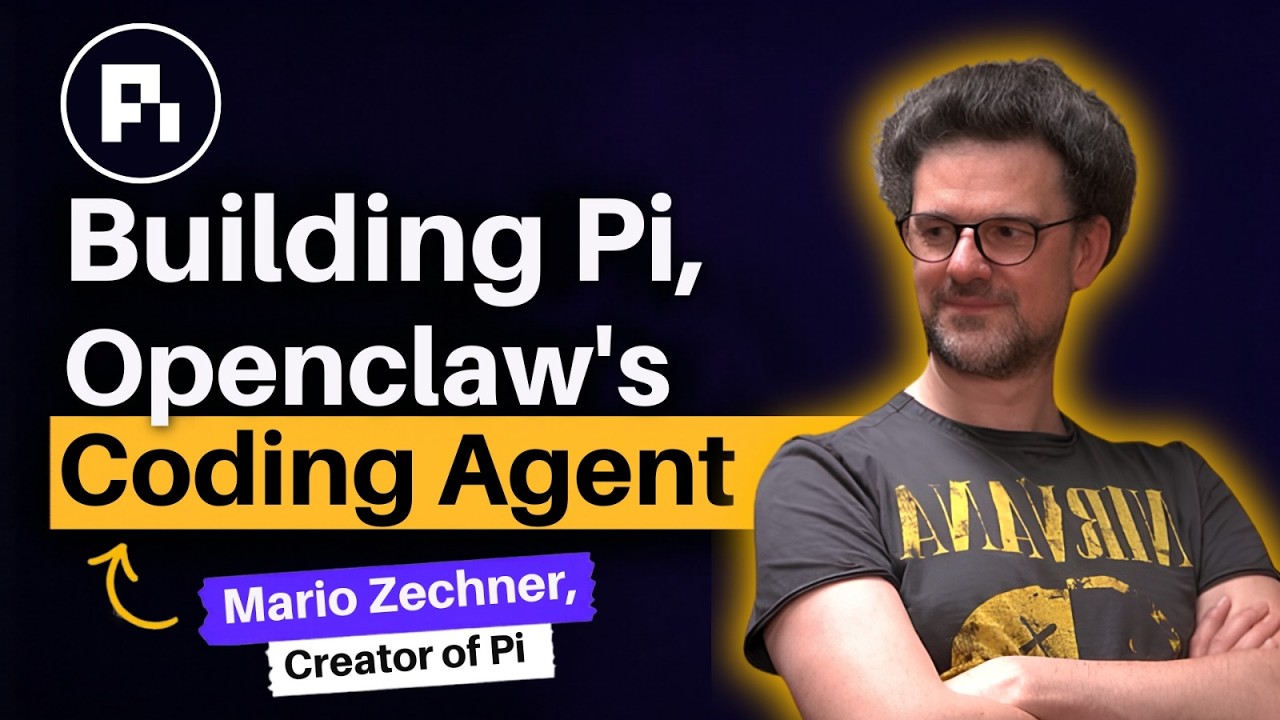
The Modern Software Developer
Pi Building Pi, Openclaw's Minimalist Coding Agent | Mario Zechner, Creator of Pi • Jun 14
- Mario Zechner argues current models lack sufficient RLHF data on software architecture and design, making them ineffective at structuring solutions.
- Zechner uses agents on modular, well-architected code where boundaries are clear, but reserves final oversight for mission-critical and security-related components.
- Zechner built Pi, a minimalist coding agent harness based on a small, extensible core that users can modify themselves to fit workflows, opposing heavy feature-driven designs.
- Zechner avoids MCP integrations in Pi, citing issues with server implementations wasting context tokens on tool definitions and preferring direct CLI use.
- Zechner's workflow for bug fixes includes using Pi with an issue prompt template to fetch, label, and analyze GitHub issues, verifying the analysis before implementing.
- Zechner manually reviews agent-generated code to combat unnecessary abstraction and complexity, using a custom Pi extension to provide inline feedback.
- Zechner's agents.md file defines coding style and rules, but notes models often ignore it, relying more on deterministic linting and type-checking for enforcement.
- Zechner says agents can massively degrade a codebase faster than human teams, requiring ruthless refactoring, but believes they can also assist in that cleanup.
- Zechner uses GPT-5.5 as his daily driver for code but switches to Claude for prose, and dabbles with open-weight models like Kimi 2.6 and DeepSeek.
- Zechner avoids automatic worktree creation in Pi, citing distrust of models handling complex git operations and relying on modular code to prevent file conflicts.
- Zechner refactors large codebases by first using the agent to explore and summarize relevant files, then carrying that summary into a separate implementation branch within the session.
- Zechner built a robot with a Pi brain over 12 hours, using voice-to-text and agent-generated frontend code, then refactored the messy result by modularizing tool implementations.
- Zechner advocates adversarial agent roles to push back on user ideas and prevent sloppy code, referencing Matt Shumer's 'roast me' skill as an example.

The AI Government Is Already Here | Simon Dixon on The Peter McCormack Show w/ Peter McCormack • Jun 12
- Simon Dixon argues the world is transitioning toward a 'one-world government control grid' built on programmable money, social credit scores, and AI. He believes fighting this agenda is futile.
- He describes a model of 'freedom of speech but not freedom of reach'. Dixon thinks AI and social credit systems will profile your speech and only boost narratives they approve.
- Dixon believes algorithms radicalize users by feeding them content that reinforces their existing worldview, creating a 'doom loop' to maximize device time and profiling.
- AI is crushing big businesses but decentralizing tech power to small ones. Dixon built integrated business software in 9 days using AI agents, replacing a £1 million project with a 12-person team.
- Coinbase announced a 17% layoff and shift to a 'flat hierarchy' for AI-first operations, exemplifying how large companies must adapt to AI for productivity boosts.
- Peter McCormack hit a token limit on Claude and sees it as a warning that centralized AI companies can 'turn you off', highlighting the need for decentralized alternatives.
- China's DeepSeek AI is funded by Huawei and performs at 90% of US AI capability at a tenth of the cost, according to Dixon.
- The UAE received an FX swap line from the Federal Reserve, allowing it to create dollars. Dixon says the UAE is the global center for sanction circumvention.
- Capitalism and communism are false dichotomies designed to feed the same central banking system and justify war, both leading to concentrated power, according to Dixon.
- He advises young people to skip university, learn AI/robotics to help businesses transition, own assets that beat inflation, and ensure family wealth is structured for tax efficiency.
Also discussed on this episode: (9)
Social Media (1)
- Dixon says podcasting success is dictated by algorithms. You must hook listeners in 30 seconds and aim for over 20-minute average watch time to succeed, unless you have an established audience like Joe Rogan.
Society (2)
- He suggests 'cancel culture' was a weaponized intelligence operation to ruin dissenters' lives and then bring them back as compromised assets, citing Alex Jones as an example.
- He identifies three power categories: debt slaves, captured corporate elites like Elon Musk, and the rare 'sovereign zone' of rich, influential individuals with self custody and no debt.
Media (1)
- Media power, not money, dictates narratives. Dixon says media is captured as public companies, founders become subordinate to sponsorships, and algorithms teach hosts what to say.
Protocol (1)
- Dixon claims the 'financial industrial complex' captures Bitcoin companies via venture capital, banking relationships, licenses, and board seats, stripping them of their decentralized ethos.
Politics (3)
- World War III is impossible because the US military-industrial complex relies on China's supply chain, says Dixon. He argues the narrative is pushed to serve a 'bigger agenda'.
- Dixon outlines a multipolar world shift: Iran mines Bitcoin with nuclear energy, UAE holds the Mbridge CBDC network, Hong Kong takes gold derivative clearing from London, and BRICS grows.
- Politics is a waste of energy. Dixon advises people to build for themselves, their family, and community, and to vote with their money instead.
Philosophy (1)
- Dixon's 'golden pill' philosophy is accepting reality and building your world within it, having moved beyond blue pill naivety, red pill awakening, and black pill despair.
Hermes Agent, NotebookLM & LiveKit Founders on the AI Agent Race | TWiAI 17 • Jun 10
- Jeffrey Cannell reports Hermes Agent is now ranked number one on Open Router and recently launched a desktop app, marking rapid growth over the last three months.
- Steven Johnson explains Notebook LM's foundation is a source-grounded AI experience, providing state-of-the-art citations and audio overviews, with its most significant update integrating its separate research, creation, and source-analysis agents into a single chat agent.
- Russ D'Sa reveals LiveKit powers voice AI for high-profile clients including Spotify, Tesla's support and service centers, Grok Voice, Salesforce's Agent Force, and SAP's Joule.
- Steven Johnson contrasts Harvard Law's mandatory use of Notebook LM for a constitutional law class with Berkeley Law's restrictive AI policy that only permits AI for finding sources.
- Jeffrey Cannell argues AI agents will automate much entry-level work, creating a disconnect between college preparation and a tightening job market.
- Steven Johnson advocates using AI as a world-class tutor and editor to amplify cognitive processes rather than bypass learning, a framework he believes would make AI skills valuable in any future job market.
- Panelists critique Apple's new Siri AI for a persistent user experience problem where users don't know its capabilities, making it slower than using a browser, and for lacking a conversational, human-like interaction flow.
- Steven Johnson is optimistic about Apple's standalone Siri app as a potential new AI application paradigm, citing Apple's history with breakthrough apps like GarageBand and HyperCard.
- Jeffrey Cannell suggests Apple may have avoided training frontier models because the costs are prohibitive and a fourth player was unnecessary, instead partnering with Google and investing in open-source via their MLX platform for Apple Silicon.
- Russ D'Sa predicts the ultimate winners in AI will be platforms that transcend specific devices for digital work automation and companies focused on embodied AI robots for physical chore automation, not device-centric players like Apple.
- Jeffrey Cannell describes reaching 'functional AGI' where on specific tasks, AI is as good as the best humans, citing his own transition from writing code manually to using AI for all coding work.
- Panelists agree Claude Opus 4.5 was the inflection point where AI coding models crossed a threshold to become better than human developers, leading to a phase of rapid, reliable agentic automation.
- Jeffrey Cannell identifies corporate 'token maxing' as a failure case where employees use unlimited AI budgets inefficiently, while high-performers can be worth 10x the token spend, a value hard to assess at large scale.
- Russ D'Sa notes his top engineers spend up to $10k-$15k monthly on AI tokens, which he considers a high-value investment that turns them into vastly more productive workers.
- Jeffrey Cannell states current smaller local models lack the quality for coding agents compared to frontier models, and the scaling trajectory points to ever-larger models, making local high-performance compute a niche.