Companies are bringing routine AI back inside
- Companies are moving high-volume AI work toward open models to reduce token bills and keep sensitive data in-house.
- The shift is practical, not total: open models can handle routine work while frontier systems tackle harder tasks.
- Ollama’s CEO says Fortune 500 adoption is widespread, but his figures aren’t an independent measure of model replacement.
The draw of open AI models is becoming less about ideology and more about control: companies want to avoid rising bills for routine, high-volume tasks and keep sensitive work inside their own systems. Across the shows, the emerging picture is a hybrid setup - not a wholesale retreat from frontier labs, but a move to use cheaper, locally run models where they are good enough.
On Oct 9, Reflection AI co-founder Misha Laskin argued on No Priors that open models can help enterprises cut costs and control their computing. He said companies spending more than $100 million a year on closed-model APIs were shifting workloads to their own hardware. Reflection’s Beam model, he reported, used more than 10,000 GB300 GPUs for four weeks of reinforcement learning - an example of the substantial resources needed to build competitive open models.
On Oct 12, Breaking Points connected cheaper Chinese models to a broader risk for U.S. AI investment. The show relayed Jefferies strategist Chris Wood’s warning that falling model prices could undermine the returns expected from debt-financed data centers. That is a warning about the economics of the infrastructure boom, not proof that companies have abandoned paid APIs. But it helps explain why buyers are looking for alternatives before committing to recurring usage costs.
On Oct 14, Nathan Lambert of the Allen Institute for AI offered a qualification: open models can approach the frontier within two to three months, but he said distillation does not explain that progress at scale. He expects open models to serve buyers who value lower cost and control, while closed labs retain an edge in some high-value work. The practical choice, then, depends on the task - not a simple contest with one winner.
The latest account, on Oct 15, comes from Ollama CEO Jeffrey Morgan on This Week in AI. Morgan said more than 85% of Fortune 500 companies had deployed Ollama on their networks, and that its cloud business had grown more than 200-fold since the start of the year. Those are Morgan’s company figures, not an independent census, and deployment does not mean firms have replaced closed models. He also described local decision models answering in under 10 milliseconds, compared with more than 100 milliseconds for a data-center round trip. Morgan expects routine work to move closer to users; what remains unclear is how much enterprise spending will actually follow.
Source Intelligence
- Deep dive into what was said in the episodes
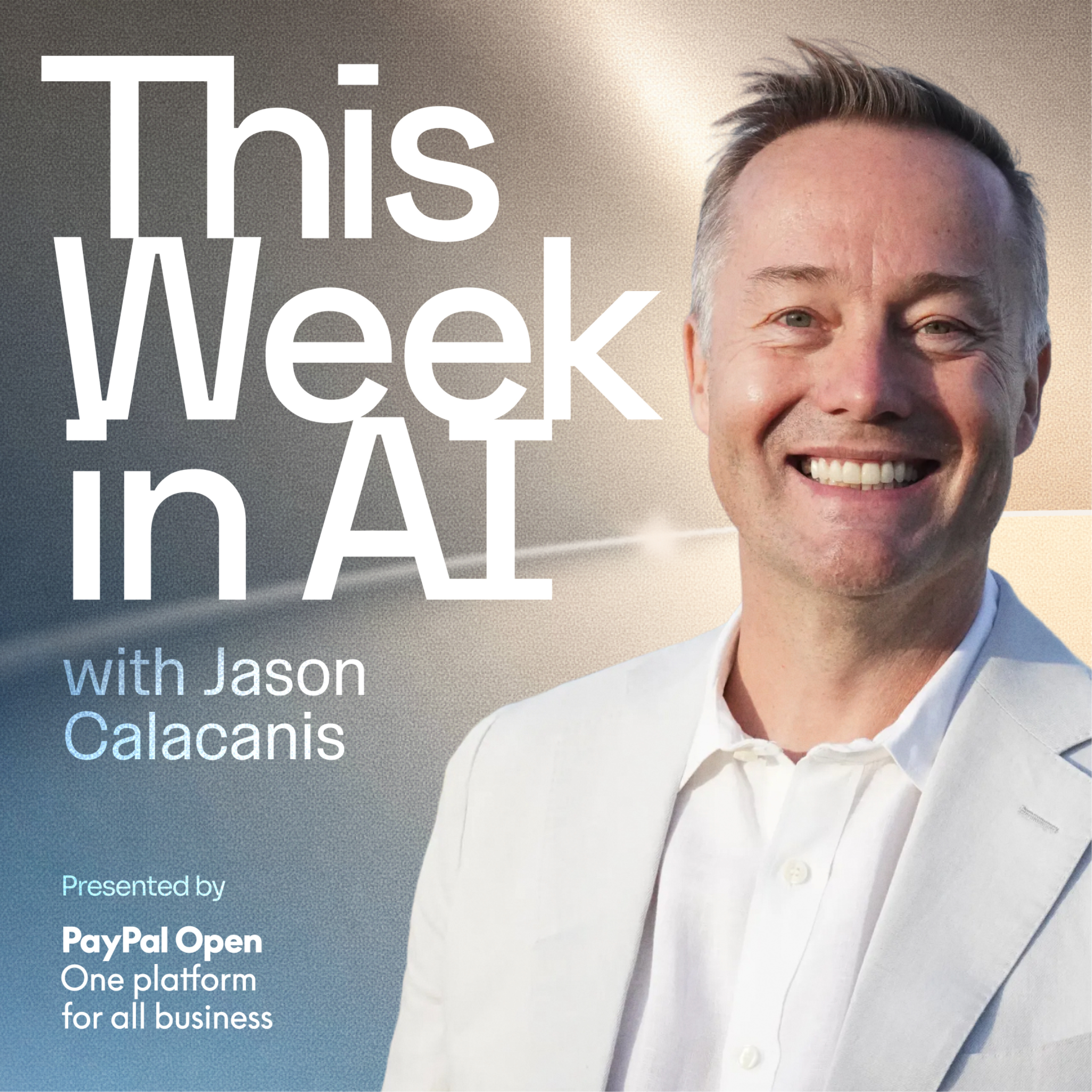
Why Fortune 500 Companies Are Quietly Switching to Open Models • Oct 15
- Jeffrey Morgan says Olama launched as an open-source project just over three years ago and has grown to more than 9 million monthly developers. He says over 85% of Fortune 500 companies have deployed Olama on their networks, while its cloud business has grown more than 200-fold since the start of the year.
- Jeffrey Morgan says enterprise demand for open models accelerated in the last six months, and especially the last three, as coding agents drove up token use and the cost of completing business tasks. Open models let companies run high-volume workloads more cheaply than relying entirely on frontier APIs.
- Jeffrey Morgan says European customers are wary of sending company data to both Chinese and U.S. model providers. Short-term data-retention requirements, including periods of weeks or 30 days, strengthen demand for local control and data sovereignty.
- Jeffrey Morgan says companies want to own their AI stack because model providers can build products that compete with customers, while controlling the infrastructure, model, and application. Enterprises want to protect proprietary data and know-how and use AI in ways that preserve their competitive advantage.
- Jeffrey Morgan says the capability gap between open and frontier models has largely closed for general-purpose business work, though frontier training still matters for specialized tasks such as math, biotech, and cybersecurity. He cites open models ranging from 120 billion parameters to several trillion, and estimates most business tasks do not need frontier-level reasoning.
- Jeffrey Morgan expects a hybrid pattern in which laptops handle routine inference and cloud systems take harder workloads. He predicts that within a year, 90% of regular-difficulty workloads could run locally on desktop computers.
- Jeffrey Morgan says on-desk AI systems fill the gap between laptops and large cloud deployments: enterprises get data locality and privacy with near-data-center performance. He says NVIDIA's DGX Station has almost a terabyte of VRAM and can run a trillion-parameter model.
- Jeffrey Morgan says long-horizon agents let users assign work involving files and tools, then return later for the result instead of staying in the loop. Coding agents and desktop interfaces that run many tasks at once are driving substantially higher token use.
- Jeffrey Morgan says decision models make fast, narrow judgments rather than generating long reasoning chains. Developers can replace complex rule-based code with a model that returns a simple classification or score, reducing code and speeding up applications.
- Jeffrey Morgan says some open decision models respond in under 10 milliseconds locally, compared with more than 100 milliseconds for a round trip to a data center. Some providers charge no output-token fees for these models, while an ultra-fast model can cost hundreds of dollars per million output tokens.
- Jeffrey Morgan says Fortune 500 customers often run five or six AI harnesses and are building routers to choose which model and harness handles each task. He calls the coordinating layer orchestration or a meta-harness, with routing, security, governance, and performance as core functions.
Also discussed on this episode: (4)
AI Infrastructure (1)
- Jeffrey Morgan points to Microsoft and NVIDIA's new Windows ML stack and RTX Spark hardware as signs that data-center and desktop architectures are converging. He says the announced desktop system delivers a petaflop, while existing server rooms could host fleets of these devices, though power and cooling remain practical constraints.
Models (1)
- Jeffrey Morgan describes the model timeline as moving from GPT-3-era pretrained models to reasoning, tool use, coding agents, and long-running agents. He dates the reasoning wave to late 2024, the DeepSeek open-reasoning moment to early 2025, and open tool-calling models to later that year.
Open Source (1)
- Jeffrey Morgan says open models give security and biotech teams access to capabilities they may not be able to use through closed services. He views AI as powerful software rather than sentient, but warns that model stacks need added safety and security layers as code generation and supply-chain risks grow.
Startups (1)
- Jeffrey Morgan says Olama charges customers by token at market rates, avoiding the fixed hourly cost of renting GPUs. Morgan previously founded a startup in 2013 that Docker acquired; Olama is his second startup, a small in-person team hiring people who use coding agents heavily.

Can Open Models Keep Up With the AI Frontier? | Nathan Lambert • Oct 14
- Lambert argues that Chinese labs release open models to gain distribution and reach customers, a practical startup strategy rather than evidence of government direction. He expects open models to sit a step behind premium closed models, serving markets where ownership and lower cost matter.
- Lambert says distillation can save compute by training on a stronger model’s outputs, but public research does not show it explains China’s model progress at scale. He estimates it may shorten the gap by a few months and says the strongest reasoning traces are difficult to reproduce in open training.
- Lambert says open models have sometimes approached the frontier within two to three months, while closed labs can protect reasoning outputs by limiting API access. He views model distillation as competition, though he recognizes national-security concerns and opposes government action over terms-of-service violations.
- Lambert expects closed labs to reach high-value markets first because they combine model development, inference infrastructure, and customer feedback. Open-model businesses move more slowly across model builders, inference providers, and post-training firms, but can ultimately give customers control of weights and private data.
Also discussed on this episode: (12)
Models (6)
- Nathan Lambert says model progress depends on compute, data, and talent, plus the ability to organize them. OpenAI and Anthropic have made the earliest, most ambitious bets; Meta’s reset put it back on a positive trajectory.
- Lambert says frontier gains in less-verifiable fields such as law, health care, and biology depend heavily on costly, high-quality data. In math, code, and some machine-learning engineering, clearer measures of success let models improve through verifiable tasks and better software.
- Lambert says AI labs buy and generate synthetic training environments at scale, but data vendors often prioritize sales over model behavior. Flawed tasks can invite reward hacking, so labs and vendors need to work together on data quality and evaluation.
- Lambert sees pre-training as relatively accessible because researchers can build on open tools and internet-scale data without spending billions. Post-training is harder: it requires specialized expertise in supervised fine-tuning, reinforcement learning, mid-training, and fast experimentation.
- Lambert expects model-serving costs to fall sharply, while Lisa Lee notes that open fine-tunes can already perform well enough for specialized coding tasks. Lambert says costs could halve every eight months for three years, potentially reaching 1% of the starting cost after four years.
- Lambert doubts that current scaling alone guarantees a sudden takeoff: labs spend exponentially more compute for roughly linear performance gains, and human bottlenecks remain. He says a substantially different discovery could change that view, but cited cloud-system cards describing roughly 10X more progress as necessary for fast takeoff.
China (1)
- Lambert says Chinese labs have talent comparable to US labs but far less compute; one leading Chinese researcher was stunned to hear that an average OpenAI researcher could access 5,000 H100 equivalents.
Open Source (1)
- Trillium plans to release open environments for high-value tasks, including synthetic terminal tasks built with frontier-model prompts and checked for bugs through model rollouts. Lambert says shared environments and RL trajectories can give researchers a common basis for studying model behavior.
Safety (2)
- Lambert wants Trillium to document how AI research itself is automated: tasks, tools, compute, configurations, and model failures. He argues that visible evidence of what models can and cannot do would help policymakers assess recursive self-improvement without relying on vague claims.
- Lambert worries more about weak public preparation for cybersecurity and other existing risks than about imminent recursive self-improvement. He argues that open research and broader scrutiny can help society understand risks as capabilities spread from closed labs to open models.
Agents (2)
- Lambert says AI agents make open research harder by flooding repositories with low-quality issues and fabricated claims. Meaningful contributions still require months of study and coding, and researchers may wait six to eighteen months for their work to gain notice.
- Lambert says frontier labs may lead in large agent swarms and coordination systems, but their methods will spread as customers seek models that work across different harnesses. He expects ideas to leak through researcher networks, while compute and inference infrastructure remain harder advantages to copy.

10/12/26: OpenAI $20 Billion Short Of Promises, Historian On Collapse Of Weimar Germany • Oct 12
- Jefferies analyst Chris Wood warns that the US artificial intelligence boom will lead to massive capital destruction. He claims open-source Chinese models now provide comparable performance at significantly lower prices.
- Saagar Enjeti highlights that major AI hyperscalers are expanding data center infrastructure through high-interest debt rather than cash flow. Emerging low-cost Chinese models jeopardize the long-term profitability required to service those loans.
Also discussed on this episode: (8)
Big Tech (1)
- OpenAI signaled an annualized revenue figure near $50 billion for September, trailing the $70 billion previously reported to investors by $20 billion. Following the news, Nvidia stock fell 2.9 percent and Oracle dropped 5.5 percent.
Coding (2)
- Software developers utilized Claude Opus 5.5 to reverse engineer Adobe's core software suite into seven open-source Rust applications. Krystal Ball notes this dynamic threatens traditional software business models by removing technical moats.
- Chamath Palihapitiya claims that artificial intelligence tools and headless application architectures have rendered software intellectual property worthless. Developers can now easily decompile, distill, and replicate legacy multi-billion dollar software products.
History (4)
- Historian Victor Sebestyen argues the fall of Weimar Germany was not inevitable, emphasizing that specific events and individual decisions shaped the outcome. A single bullet missing Adolf Hitler in 1923 could have altered world history.
- Paul von Hindenburg won the 1925 German presidential election only because the Communist Party ran a spoiler candidate, according to historian Victor Sebestyen. Hindenburg used his position to undermine the democratic republic he despised.
- German statesman Gustav Stresemann stabilized the currency and oversaw Europe's fastest-growing economy between 1924 and 1929. Victor Sebestyen notes Stresemann's sudden death in 1929 removed a crucial leader capable of navigating the Wall Street crash.
- Soviet Russia financed an armed communist insurrection in Germany following World War I while suffering over 20 million civil war casualties. Victor Sebestyen notes this geographical proximity created genuine fear among the German middle class.
Censorship (1)
- The immediate post-1918 removal of censorship in Weimar Germany triggered a surge in modernist art and culture. Saagar Enjeti and Victor Sebestyen explain how right-wing forces weaponized this sudden cultural shift to incite a conservative backlash against urban elites.

Beam: The Great American Open Model with ReflectionAI Co-Founder and CEO Misha Laskin • Oct 9
- Reflection AI launched Beam, a 500-billion parameter open-weights model optimized for coding and agentic workflows. Co-founder Misha Laskin expanded the lab from 30 to 300 employees over twelve months to build the end-to-end training pipeline.
- Beam achieves a three to fourfold efficiency gain over equivalent capability models by scaling reinforcement learning to optimize execution speed. Misha Laskin notes this design yields up to a 10x efficiency advantage against larger models on terminal tasks.
- Reflection AI allocated over 10,000 GB300 GPUs for four weeks to reinforcement learning, surpassing the compute dedicated to pre-training. Infrastructure and algorithmic improvements cut Beam's pre-training phase down to 12 days.
- Frontier model catch-up capital escalated from $100 million to single-digit billions within 18 months, heading toward tens of billions for upcoming generations. Every new model generation requires roughly a 4x multiplier in total raw compute.
- Pre-training compute efficiency improves by roughly 7x annually, while reinforcement learning efficiency gains reach up to 30x per year. Misha Laskin emphasizes that using models to refine training algorithms accelerates progress beyond human researcher capabilities.
- Open model token consumption on major developer gateways inverted from 30 percent to 70 percent within six months. Misha Laskin projects open models will capture over 95 percent of server workloads, mirroring Linux's enterprise dominance in operating systems.
- Enterprises spending over $100 million annually on closed model APIs are pivoting to open models on bare metal to control costs and secure compute. Organizations initially customize agentic system harnesses before attempting direct fine-tuning.
Also discussed on this episode: (4)
China (1)
- Chinese state subsidies and industrial-scale distillation drive rapid advancements in Chinese open models. Misha Laskin warns that open models act as geopolitical Trojan horses that lock foreign infrastructure into China's hardware and cloud ecosystems.
Safety (2)
- Stripping offensive cyber capabilities from models destroys defensive security tools. Applying Linus's Law to AI safety, Misha Laskin contends that broad crowdsourced access to open weights provides superior defensive capabilities compared to restricted closed systems.
- Public discourse focuses heavily on theoretical AI existential risk rather than practical alignment engineering. Misha Laskin explains that model safety functions like software bug patching using targeted post-training datasets rather than complex theoretical proofs.
Models (1)
- Frontier models progressed from undergraduate-level reasoning to executing PhD-level physics calculations and generating novel research hypotheses within two years. Misha Laskin notes this advancement compresses multi-year PhD projects into weekly iteration cycles.