No Agenda’s finale closes one chapter for Adam Curry
- No Agenda is set to end with its 1,916th episode on October 29.
- Adam Curry says he will keep making media with a Christian perspective through Godcaster.
After 19 years, No Agenda is set to end with its 1,916th episode on October 29. Adam Curry said the decision followed the show’s anniversary and the death of co-host John C. Dvorak earlier this year.
Curry said he and Dvorak’s family agreed the podcast depended on the partnership between its two original hosts. The finale closes the show rather than handing Dvorak’s place to a new co-host.
Curry’s next chapter includes making media with a Christian perspective through Godcaster, which received an NRB innovation award. The end of No Agenda, he said, does not mean the end of his media work.
Source Intelligence
- Deep dive into what was said in the episodes

Adam Curry
Doomsday Detox • Oct 28
- Adam says No Agenda’s final episode follows the show’s 19th anniversary and comes after co-host John’s death; he plans to keep making media with a Christian perspective through Godcaster, which received an NRB innovation award.
Also discussed on this episode: (16)
Health (2)
- Pastor Jimmy says applying for Medicaid triggered an unexpected low mood as he confronted aging; hearing problems then sharpened a disagreement with his wife, though the distress lasted only hours.
- Adam says the COVID shutdown taught him to assess new crises without panic; he recalls that his church closed for about 11 weeks after he followed the initial direction from Donald Trump, and says he focuses on lessons rather than self-reproach.
Agents (1)
- Adam used a robot assistant to complete his passport renewal form, print the PDF from his phone, and avoid another bout of procrastination; he still had to enter his Social Security number himself.
Education (1)
- Pastor Jimmy says Taylor University’s enrollment has more than doubled as students choose a campus that keeps Christian faith central and holds to biblical convictions.
Religion (7)
- Pastor Jimmy reports that Run With Christ grew from a Columbus running group into gatherings where young people run, worship, hear the gospel, and connect with local churches; Adam says belonging helps young people find social support.
- A young Austin visitor named Lauren told Pastor Jimmy and Annette that their church’s close-knit community stood out; the hosts argue that face-to-face groups and shared discipleship offer connection that online content cannot replace.
- Adam recounts Vice President JD Vance pausing a Nebraska rally to pray for an attendee who collapsed, then checking on the person; Adam calls prayer an instinctive response and says Vance credits Charlie Kirk with helping him return to Christ.
- Pastor Jimmy cites reports of large baptism efforts across countries, including a beach event in Maputo organized with local churches; he says the spread of baptisms matters more than the size of any single event.
- Adam praises developer Jonathan’s Lamplighter Bible app for disguising scripture as a game, supporting many languages, and allowing Android sideloading; the design targets people in countries where Christianity is restricted.
- Jonathan is building Breach, a shared prayer app for coordinated prayer, drawing on Ephesians 6:12 and Matthew 16; Adam says Christian practice is strengthened by praying and learning with other people.
- Pastor Jimmy’s sermon applies Revelation’s message to Ephesus: recover first love by remembering, repenting, and returning to prayer, worship, scripture, and community; after more than 43 years as a pastor, he says spiritual commitment naturally moves through stronger and weaker seasons.
Media (3)
- Adam says fear-driven conspiracy narratives recur around elections, linking unrelated events into a looming civil war, blackout, or financial reset; he argues the cycle sells both products and politicians, and past predictions he tracked did not materialize.
- Adam says coverage escalated Senator Elissa Slotkin’s call to deter young people from joining the Trump administration into claims of a planned coup; a DSA call discussed a possible governor briefing on a “doomsday scenario,” not street mobilization.
- Adam describes the “Black October” cybersecurity framing as an overreaction to a PHP vulnerability that was disclosed before all users had installed a patch; he says everyday services kept working and the episode did not amount to a global cyber meltdown.
Nation-State (1)
- Secretary of War Pete Hegseth presented Fortress America as a plan to power military bases independently, bring critical supply chains home, and stock reserves; Adam calls the policy ordinary defense planning rather than evidence that war or collapse is imminent.
Models (1)
- Adam says Brian Albright is using open-source local AI models for himself and his customers, reflecting a preference for tools users can run and control rather than relying entirely on external services.
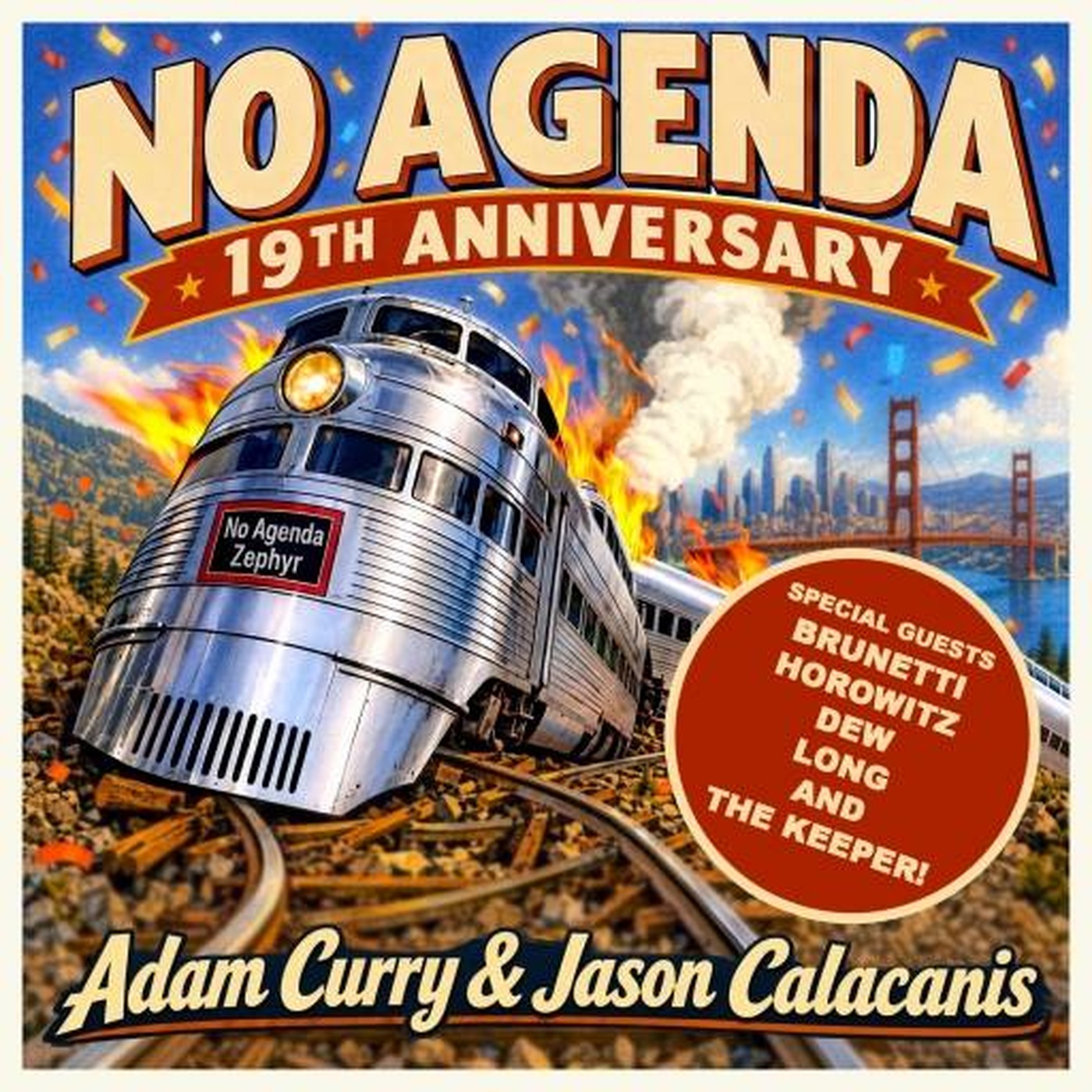
Adam Curry
1915 "Off The Rails" • Oct 25
- Adam Curry announced that No Agenda would end after its Thursday episode because he and the Dvorak family agreed the show depended on both Adam and John C. Dvorak. The family plans a different show called Party Line, while Adam plans to revive Curry and the Keeper and continue We Get to Do This; the existing company is split 50-50 between Adam and John’s successor, Mimi.
- Jason Calacanis proposed using AI versions of John C. Dvorak and Scott Adams to continue their shows, arguing Dvorak would find the idea funny; Adam Curry said the Dvorak family did not agree. Jason also suggested an occasional No Agenda reunion show triggered by $10,000 in listener donations, while Adam said the show would continue honoring challenge-coin and knighthood commitments.
Also discussed on this episode: (14)
Startups (1)
- Jason Calacanis sold bootleg copies of The Empire Strikes Back at school after his father brought home a bootleg VHS; at 15, Jason learned to copy tapes in real time and called his business Jason’s Hot Tapes. A math teacher bought a copy after confronting him, which Jason remembers as his first lesson in capitalism.
Society (3)
- Jason Calacanis says people increasingly treat a friend’s political views or actions as the responsibility of everyone associated with that person. Jason says he knew Elon Musk before Tesla and objects to being treated as Musk’s spokesperson when appearing in media discussions.
- Jason Calacanis says young Americans lose faith in the American dream when housing is unaffordable, college debt does not lead to adequate work, and healthcare threatens financial security. He argues that those pressures make government-provided benefits more appealing, while high taxes can push entrepreneurs elsewhere; he also points to low unemployment among people over 50.
- The episode’s side discussions included Jason Calacanis’s roughly 40-acre Texas property and his claim that he keeps multiple power and water sources and ammunition for emergencies. He described downloading instructional videos for offline use; the group also discussed chicken losses, feeding deer, and Matt Long’s planned Veterans Day speech drawing on Benjamin Franklin’s support for veterans.
Elections (1)
- A replayed This Week in Tech exchange criticized corporate political spending and Citizens United, citing Elon Musk’s reported $250 million contribution and a $25 million corporate donation to a White House ballroom. The discussion also cited Netflix giving Barack Obama $30 million to produce podcasts, while Jason argued customers can judge companies by their products and choose where to spend.
Regulation (1)
- Jason Calacanis distinguishes securities fraud from ambitious public product claims: lying to investors about clients or employees can trigger securities-fraud liability, while a product pitch has more room for claims about future goals. Jason says Elizabeth Holmes was convicted for lying while selling securities, even though he believes small blood samples will eventually support many tests.
Macro (1)
- Jason Calacanis says moving to Texas changed his political outlook after years in California, where he saw hostility toward business owners, homelessness, high taxes, and restrictions on housing construction. He argues that limited housing supply worsens the American-dream crisis; he says Austin home prices had fallen for four consecutive years, while France and Denmark fund more government services with much higher taxes.
Immigration (1)
- Jason Calacanis argues that immigration can weaken national cohesion when newcomers do not assimilate, while legal immigration that benefits the country can strengthen it. He cites Canada’s population and recent immigration as an example of a pace he considers unsustainable; Andrew Horowitz adds that understanding a country’s history and institutions is necessary for people to feel attached to it.
Media (3)
- Rob Deucifer says audiences are turning away from legacy news because they see its coverage as propaganda and prefer commentary that filters claims for them. Jason Calacanis argues that recommendation algorithms extend viewing sessions by pushing users toward more extreme content, while media outlets increasingly build clips for virality instead of appointment viewing.
- Jason Calacanis praised a documentary about Elizabeth Holmes for exploring the line between entrepreneurial ambition and delusion, and criticized director Alex Gibney’s Musk documentary as a failed, four-hour hit piece. Jason said the Musk film made only half a million dollars and had been pulled from theaters.
- The discussion recalled John C. Dvorak as a relentless product critic who used harsh complaints to push companies toward better products. Adam Curry says Dvorak was usually right in their disagreements and would acknowledge mistakes; Andrew Horowitz recalled Dvorak’s food and wine tangents, while Dana Brunetti described his expensive restaurant choices and persistent bits.
Religion (1)
- Andrew Horowitz argues that weakened organized religion and family life leave people searching for belonging, while social media can intensify that search. Matt Long says social platforms consumed his time and that real-world events, rather than online feeds, now drive his anger; he says he stopped using social media after leaving X.
Agents (1)
- Jason Calacanis says shopping agents can compare subscriptions, bank fees, and product prices, then act with a user’s credentials; he describes payment access as separate from read-only account analysis. He says established services such as Uber and DoorDash retain an advantage through driver and restaurant liquidity, while local AI models could give users more control once computers can run them effectively.
Autonomous Vehicles (1)
- Jason Calacanis says the Tesla Roadster demonstration is real but not a practical flying car, though he expects some underlying technologies to have other uses. The group also discussed electric vertical-takeoff aircraft as short-hop transport, with Adam Curry predicting dangerous accidents and Jason arguing they could be safer than helicopters.
1914 "Thrust Package" • Oct 22
- Adam Curry said No Agenda would end after 19 years, with the final episode scheduled for October 29, and said meetups would continue. Curry and Brunetti discussed a film based on Curry's unfinished book, while Brunetti warned that documentary projects rarely make money.
Also discussed on this episode: (14)
Autonomous Vehicles (1)
- Adam Curry rejected the Tesla Roadster as a practical flying car, while Dana Brunetti called the stunt an American spectacle. Brunetti watched a fake YouTube livestream that promised to double crypto sent through a QR code before realizing the stream had looped.
Space (1)
- A report in the discussion said SpaceX had its first profitable quarter, with revenue up more than 160% to $14.6 billion and AI compute becoming its largest business. Elon Musk set a target of 13 gigawatts online by the end of 2027, with another 20 gigawatts of power and cooling infrastructure planned.
Big Tech (1)
- Musk said he would give one SpaceX share to every American child, while Anthropic proposed placing 5% of its shares in a public-benefit fund, with a possible additional 2%. Adam Curry called the fund a vehicle for institutional control; Brunetti argued Musk's direct gift would build a base of retail shareholders.
Labor (2)
- AI job fears coexist with strong employment figures: an Economist segment cited record-high OECD employment and 3 million more U.S. white-collar jobs since ChatGPT launched. A survey across 19 countries found widespread concern, while Memphis electricians said data-center contracts were paying more than $8,000 a week.
- A report said U.S. military enlistment had reached a 15-year high, with some Gen Z recruits citing education benefits, financial stability, purpose, and camaraderie. Dana Brunetti said four years in the Coast Guard gave him discipline and direction when he could not afford college.
Agents (1)
- Adam Curry values AI agents that take actions and build tools over chatbots that merely converse; he said early chatbots produced unreliable answers and encouraged unhealthy attachment. Curry and Brunetti praised detailed prompts for custom apps, while a report said Anthropic's Duet agent was entering a market already crowded by Meta and OpenAI.
Enterprise (1)
- Getty Images was reported to be preparing for bankruptcy as it restructures debt and goes private, with AI-generated images adding competition. Adam Curry questioned why the company had not built licensing deals with AI firms, given the value of its image archive.
Europe (1)
- French unrest drew competing explanations: an NPR report described largely peaceful protests over economic conditions, while other speakers blamed radical groups and migration. An Alliance for Europe report attributed online amplification to Russian actors; Emmanuel Macron also accused foreign leaders of manipulating the aftermath.
Diplomacy (1)
- Adam Curry argued that Trump is pursuing a U.S.-Russia-China sphere-of-influence arrangement, while critics said Trump was aligning with Putin against Ukraine. Reports described a possible Trump-Putin-Xi meeting and European preparations for a post-ceasefire deployment; a British general said public resilience and sacrifice would be necessary.
Immigration (1)
- A New York-based Indonesian researcher on a G1 visa said paying U.S. taxes should give her a right to vote, although she had not voted; Adam Curry pointed out that Indonesia requires citizenship and allows only one citizenship. Curry also cited a Sacramento murder case in which a husband falsely claimed ICE detained his wife.
Media (1)
- Netflix executives blamed weak U.S. growth on execution, while Dana Brunetti pointed to bland, overly cautious programming and competition from numerous streaming services. Adam Curry questioned whether short-form video is replacing longer viewing; Brunetti said fragmented subscriptions and Wall Street's demand for constant growth also pressure the business.
Climate (1)
- A Weather Channel meteorologist predicted an exceptionally strong El Niño and warned of heavy rain in California and the southern states. Adam Curry countered that California's fires, floods, heat, and earthquakes predate modern climate debates, citing an 1860 diary that described major fires and extreme weather.
Sports (1)
- The Golden State Valkyries and Atlanta Dream left the court before the national anthem at consecutive WNBA Finals games, then returned afterward. Adam Curry called the walkout disrespectful to the military; Dana Brunetti noted that the league and teams had not explained their decision.
Health (1)
- A donor identified as Bri said a sailor in Seattle infected Bri with COVID in March 2019 and said the University of Barcelona later found the virus in an archived sewage sample from that date. Bri said No Agenda helped counter workplace disbelief; the transcript offered no independent verification of the claim.