The Frontier
Your signal. Your price.
Include
Lookback
Sequoia Capital
Sequoia Capital
- 6w ago
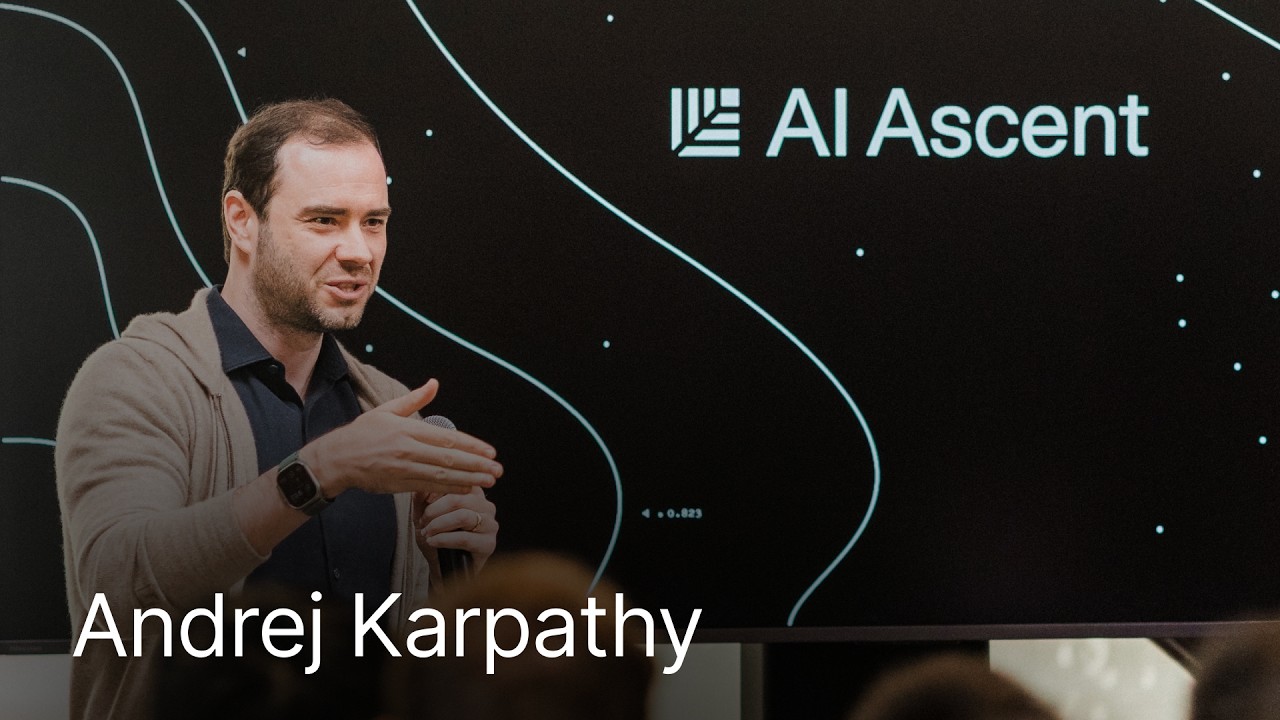
Andrej Karpathy defines software 1.0 as explicit rules, software 2.0 as learned weights, and software 3.0 as programming via prompting and the LLM context window as a lever over an interpreter.
- 6w ago
Karpathy states that OpenClaw's installation exemplifies software 3.0. Instead of a complex bash script, you copy-paste instructions for an agent, which uses its intelligence to adapt to the environment and debug issues.
- 6w ago
Karpathy says his MenuGen app, which uses OCR and an image generator to illustrate menus, is rendered obsolete by software 3.0. The raw approach is to give a menu photo to Gemini with NanoBanan and get a directly annotated image.
- 6w ago
Karpathy argues LLMs enable new applications, like automated knowledge base creation from documents, which couldn't exist before because there was no code to reframe unstructured data.
- 6w ago
Karpathy posits that future computing could invert the current architecture. Neural networks would become the host process, with classical CPUs serving as co-processors for deterministic tasks.
- 6w ago
Karpathy's verifiability framework holds that LLMs excel in domains where outputs can be verified, like code and math, because frontier labs use reinforcement learning with verification rewards during training.
- 6w ago
Karpathy cites the 'car wash' problem as current jaggedness: state-of-the-art models can refactor a 100k-line codebase but incorrectly advise walking 50 meters to a car wash.
- 6w ago
Karpathy notes that GPT-4's chess capability improved significantly from GPT-3.5 not just from scaling, but because a large amount of chess data was added to its pre-training set.
- 6w ago
Karpathy distinguishes vibe coding, which raises the floor for all programmers, from agentic engineering, which preserves professional software quality standards while using agents to accelerate development.
- 6w ago
Karpathy suggests hiring for agentic engineering should involve a large, practical project like building a secure Twitter clone and then stress-testing it with adversarial agents, not puzzle-solving.
- 6w ago
Karpathy argues that as agents handle more implementation, human skills like aesthetic judgment, taste, system design, and oversight become more valuable, not less.
- 6w ago
Karpathy describes current infrastructure as built for humans, not agents. His pet peeve is documentation that tells a human what to do instead of providing text to copy-paste directly to an agent.
- 6w ago
Karpathy endorses a tweet stating 'you can outsource your thinking but you can't outsource your understanding.' He sees LLM knowledge bases as tools to enhance, not replace, human understanding.