The Frontier
Your signal. Your price.
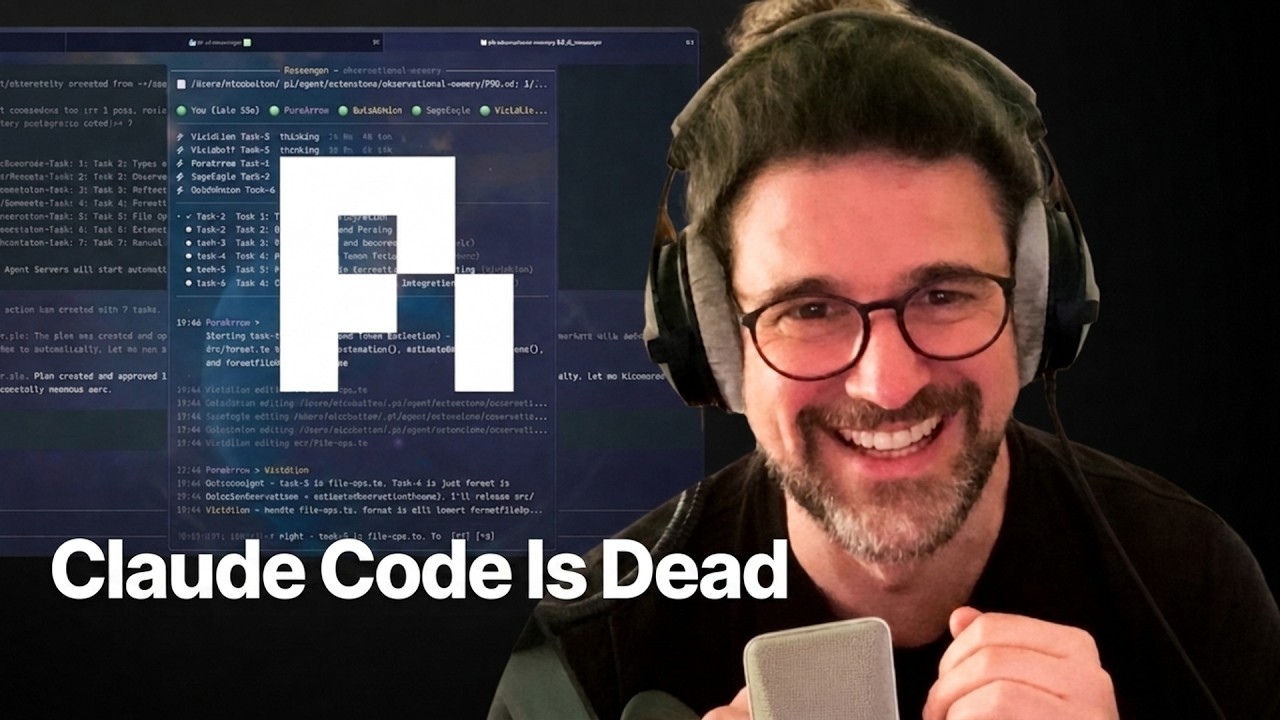
David Ondrej Podcast
- 2d ago
Mario Zechner argues most coding agents like Cursor were limited to single-file edits and lacked true codebase exploration until Entropic's Cloud Code gave agents terminal/bash access, enabling autonomous 'agentic search' that unlocked real coding automation.
- 2d ago
Zechner built his own coding agent, Pi, after reverse-engineering Cloud Code in mid-2025 because he needed control over the system prompt and stability. He says commercial agents break workflows by adding features and silently altering context management.
- 2d ago
Zechner attributes perceived model degradation more to psychological 'honeymoon periods' and harness changes than to actual model quantization. He notes other harnesses using Anthropic models, like OpenCode, don't report the same degradation.
- 2d ago
The biggest benefit of AI agents is internal productivity for non-technical staff. Zechner's wife, a linguist, used Cloud Code to write Python scripts for data analysis, 5xing her output. David notes his video editors use agents to build internal tools for spotting outliers and making thumbnails.
- 2d ago
Zechner believes AI access will become a 'rich man's game,' giving those who can afford tokens a massive edge. He notes a $200/month plan is a barrier for most people, though software developers see it as a bargain.
- 2d ago
Open-weight models like DeepSeek and Qwen are collapsing token economics. Zechner runs Qwen on his own GPU cluster at cost comparable to Anthropic's API, finding its intelligence sufficient for most tasks and questioning the edge of frontier models.
- 2d ago
Enterprise brand trust, not technical superiority, drives Anthropic's adoption. Zechner says its marketing is aggressive and effective in the West, while data privacy concerns about China are equal for Europeans who distrust both the US and China.
- 2d ago
Europe lags in AI due to talent poaching by the US and a fragmented legal landscape. Zechner says setting up a pan-European company with unified stock options and investment structures is far harder than forming a Delaware corporation.
- 2d ago
Zechner sees no future for generic consumer apps like fitness trackers, as AI agents will perform those functions invisibly. He believes 'malleable, self-modifying software' is the future, where agents build custom tools on-demand.
- 2d ago
AI won't replace knowledge workers but will reshape labor markets. Zechner predicts senior workers plus an agent could replace two juniors, creating a 'chopocalypse' for young entrants and older workers who fail to upskill before equilibrium returns.
- 2d ago
Zechner distinguishes between 'digital consumers' and 'digital producers,' arguing most young people are only consumers. He says motivation, not innate neuroplasticity, determines who becomes a producer capable of building with agents.
- 2d ago
Zechner's Pi workflow uses prompt templates to autonomously handle GitHub issues and pull requests. He manually handles system design and refactoring, believing humans must understand architectural cohesion as agents often propose flawed designs based on mediocre training data.
- 2d ago
LLMs are poor at genuine creativity, like generating novel business ideas, because they can only interpolate within their training data. Zechner argues the 'squishy human parts' of taste, judgment, and experience are not encoded in tokens and may remain uniquely human.
- 2d ago
RAG loops often fail due to cargo culting. Zechner says scientific RAG with clear success criteria works, but iterative spec implementation usually doesn't. He observes a hype machine where people sell visions of 'dark factories' they know don't work yet.