The Frontier
Your signal. Your price.
The MAD Podcast with Matt Turck
- 1d ago
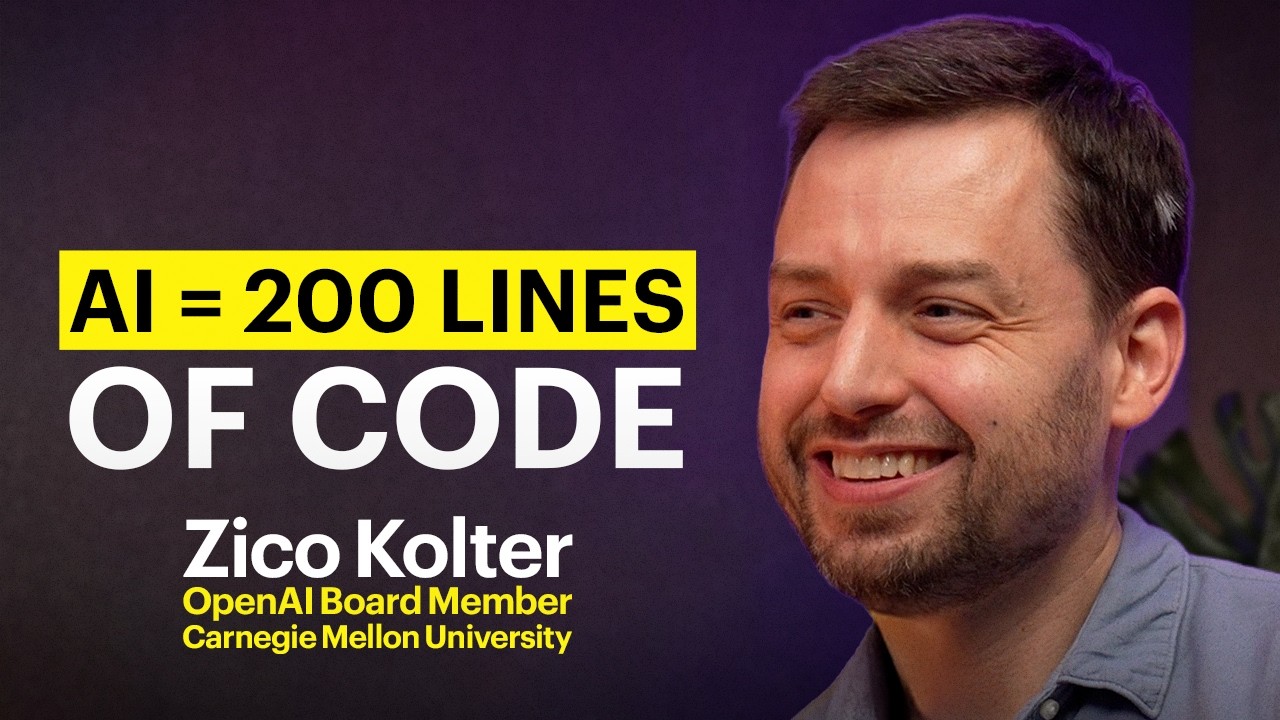
Zico Kolter argues modern AI is conceptually simple, with core LLM training and RL code achievable in roughly 200-300 lines of Python.
- 1d ago
Kolter chairs OpenAI's Safety and Security Committee, an oversight board that can delay model releases if safety evaluations are insufficient.
- 1d ago
He says model safety does not automatically improve with scale, unlike capabilities. Making models robust requires explicit safety training and additional monitoring layers.
- 1d ago
Kolter co-authored the 2023 GCG paper, which automated jailbreak generation and discovered universal, transferable attacks that worked across different models.
- 1d ago
He categorizes AI risk into four areas: model mistakes, harmful use, societal/psychological effects, and loss-of-control scenarios.
- 1d ago
Modern AI security is a multi-layered Swiss-cheese defense combining input/output classifiers, safety training, operational monitoring, and sandboxing for agents.
- 1d ago
Kolter states AI agents introduce prompt injection risks by processing third-party data, requiring careful control over their permissions and access.
- 1d ago
He believes reinforcement learning is the foundation of modern post-training, where models are trained on their own synthetic outputs selected by a reward signal.
- 1d ago
Kolter is skeptical that transformer architecture was essential, arguing other sequence models would have scaled to similar capabilities given enough compute and data.
- 1d ago
His startup, Gradient, provides third-party AI safety tools including automated red-teaming systems and custom safety models for enterprises.
- 1d ago
He co-founded Gradient in 2023 after running a large agent red-teaming competition with 1.8 million attack attempts.
- 1d ago
Kolter argues the key scientific discovery was that scaling simple architectures on vast text data produces coherent intelligence, not the specific engineering.