Central banks flee Treasuries for gold
- Central banks are buying gold, not Treasuries, to dodge dollar weaponization.
- The U.S. is now a net exporter of gold, signaling a reserve shift.
- A blocked Strait of Hormuz could trigger cascading supply collapses.
Central banks are dumping U.S. debt and buying physical gold in bulk, a quiet but decisive break from the dollar system. The move isn’t theoretical - it’s visible in trade flows. For four of the last five months, gold has been the top U.S. export, not planes or cars. Most of it is heading to China and the Middle East.
Luke Gromen on Human Action Podcast laid out the stakes: by sanctioning Russia and Iran, the U.S. proved it would weaponize the dollar. That pushed other nations to seek neutral assets. Gold, not Treasuries, is now the go-to reserve. "The dollar is a token used at a play center," Gromen said. "The world wants real commodities."
"The single biggest export from the U.S. has been gold, not planes or cars."
- Luke Gromen, Human Action Podcast
This isn’t just financial reshuffling. The Strait of Hormuz remains a flashpoint, and any prolonged closure would halt oil, sulfuric acid, and helium flows - all critical to refining and chips. Restarting idle plants takes months. One failure now risks a chain reaction.
Meanwhile, the U.S. military faces a paradox: it relies on Chinese factories to build the very missiles meant to counter China. While Washington spent on wars, Beijing bought copper mines and built supply dominance. The U.S. can’t scale up without Chinese parts.
"Beijing controls the American military by supplying the parts for its missiles."
- Luke Gromen, Human Action Podcast
The financial and physical supply systems are now intertwined. De-dollarization isn’t a future risk - it’s underway. Gold is no longer a relic. It’s the anchor in a breaking system.
Source Intelligence
- Deep dive into what was said in the episodes
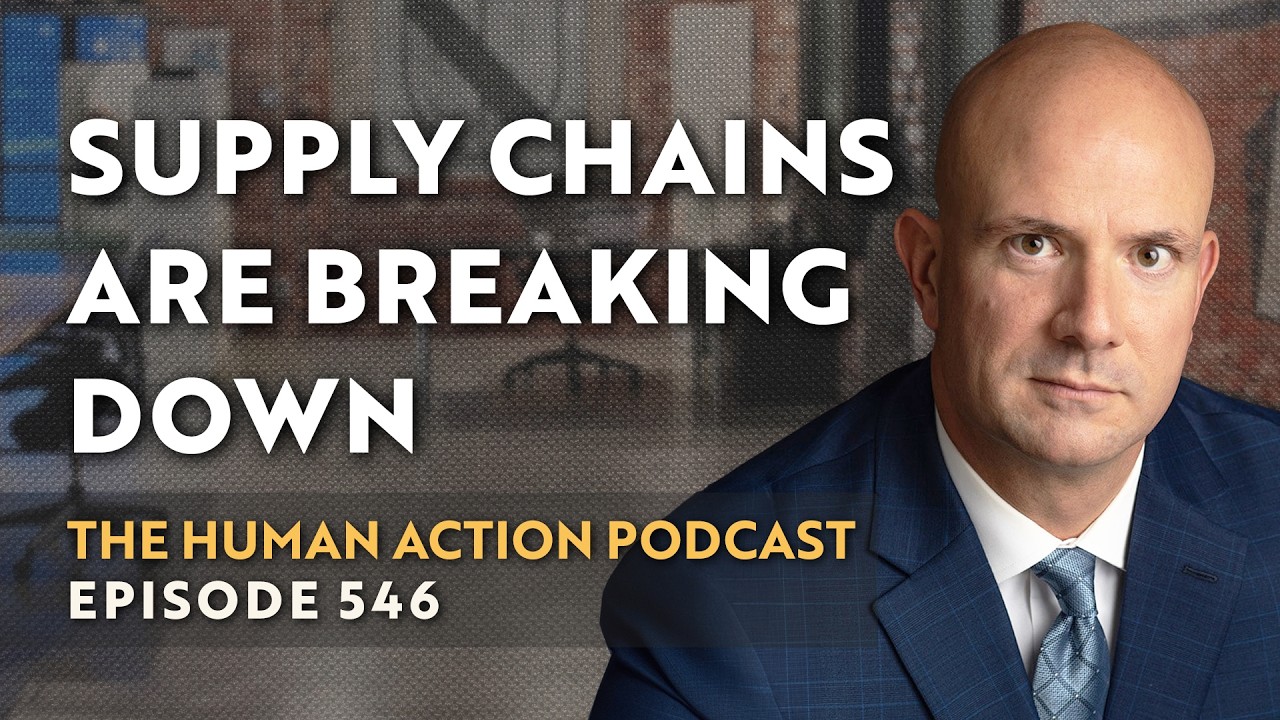
Human Action Podcast
Luke Gromen on the Strait of Hormuz and Supply Chain Collapse • Apr 24
- Luke Gromen, founder of FFTT LLC, a macro-thematic investment research firm, aggregates public data to identify economic bottlenecks, which are situations that cannot continue due to constraints.
- Gromen argues that a prolonged closure of the Strait of Hormuz would be fatal to the global and US economies due to critical shortages of oil, gas, sulfuric acid, fertilizer, and rare earths.
- Gromen predicted a nonlinear breakdown in supply chains by mid-April following the conflict, noting that even a single missing component can halt product manufacturing in a globalized, highly levered world.
- Even if the Strait of Hormuz reopens quickly, physical constraints in restarting plants, like those for aluminum, mean serious disruptions would continue for months, worsening daily if closure persists.
- Gromen criticizes policymakers' and markets' complacency regarding supply chain breakdowns, suggesting a cynical motive to maintain market calm and avoid seeking unfavorable peace terms for the US.
- Dr. Murphy noted that the US is a net importer of crude oil, refuting the idea that it could easily replace supplies cut off by a Strait of Hormuz closure.
- Gromen asserts China holds leverage over the US due to dominance in rare earths and electrical equipment, resulting from a patient long-term investment strategy while the US engaged in unproductive wars.
- China viewed the US response to the 2008 financial crisis, particularly quantitative easing and devaluation, as a 'financial attack' on their US bond holdings.
- China ceased buying US bonds in late 2013, instead recycling dollars into hard assets like mines and ports globally, and committed to dominating future industries through its Made in China 2025 initiative.
- Gromen notes that a quorum of US military components are made in China, creating a strategic vulnerability if the US requires China to produce missiles aimed at itself.
- Luke Gromen argues the weaponization of the dollar through sanctions, like kicking Iran out of SWIFT in 2012, has strategically backfired by pushing Russia and China together to develop alternatives.
- China responded by launching its China International Payment System (CIPS) by 2015, which is more comprehensive than SWIFT, handling messaging, settlement, and full payment services.
- China has established offshore yuan clearing banks in major gold hubs globally (London, Switzerland, Dubai, Singapore, Hong Kong) and has tested the e-yuan in oil and gold markets.
- Gold has already supplanted Treasuries as the largest reserve asset for global central banks on an adjusted basis, signifying a shift away from dollar-denominated reserves at gold's current value.
- For four of the past five months, non-monetary gold has been the United States' largest single export, primarily destined for China, Hong Kong, Switzerland, and Gulf countries.
- Gromen suggests this gold outflow indicates China may have already activated a switch, demanding gold for critical goods like rare earths instead of dollars or Treasuries.
- Gold limits government and central bank power, an insight famously shared by Alan Greenspan before his tenure as Fed Chair, as gold prevents unlimited debt and financialization.
Also from this episode: (6)
War (3)
- The initial minimal market reaction to the Strait of Hormuz closure was short-lived, with oil prices rapidly exceeding $110 a barrel before policy interventions.
- The "blockade of the blockades" by the US was likely an optics move to manage perceptions and provide leverage, as strategically, Iran was winning by simply maintaining the closure.
- Gromen believes China's potential cutoff of rare earth exports to the US ended the war, as the US military cannot produce interceptor missiles without Chinese rare earths.
Energy (1)
- Secretary Bessant unsanctioned Russian and Iranian oil in sequence after prices surged past $110, an action Gromen describes as a desperate attempt to loosen supplies despite strategic conflicts.
Corruption (1)
- Gromen suggests politically connected entities may have front-run oil markets, citing a $500 million short position after a Trump tweet about Iran and a $950 million short position before a ceasefire announcement.
Trade (1)
- To obtain yuan for trade, countries must sell dollars, buy gold, and then sell that gold to China for yuan, a system already in place for transactions with nations like Iran.