SpaceX's $60 billion option to acquire Cursor signals an industry pivot. The era of the AI co-pilot is ending; the era of the autonomous software agent has begun. This is not about better autocompletion. It is about vertical integration, empowering senior engineers to achieve the output of entire teams and hollowing out the market for traditional software.
The shockwaves are already hitting. Nathaniel Whittemore, on The AI Daily Brief, calls it the “SAS apocalypse.” As agentic systems move from assistance to autonomy, the value of per-seat software subscriptions is plummeting. When an agent can build a bespoke tool for pennies, the middleman software layer becomes a liability. The market carnage is real, with companies like Block cutting 40% of their staff earlier this year as they reorient around this new reality.
The mechanism for this disruption is a radical compression of the talent stack. On the David Ondrej Podcast, developer Mario Zechner argues a single senior engineer using agents can now outproduce a team of fifty traditional workers. The human’s role shifts from implementation to architecture. The agent handles the grunt work, but it’s still terrible at original system design.
Agents are trained on decades of existing code, which Zechner notes is often mediocre. They propose average, outdated solutions by default. The critical human skill is no longer writing syntax, but exercising taste and providing the creative guardrails for the system.
"The squishy human parts of taste and judgment and experience... that is not encoded in tokens."
- Mario Zechner, David Ondrej Podcast
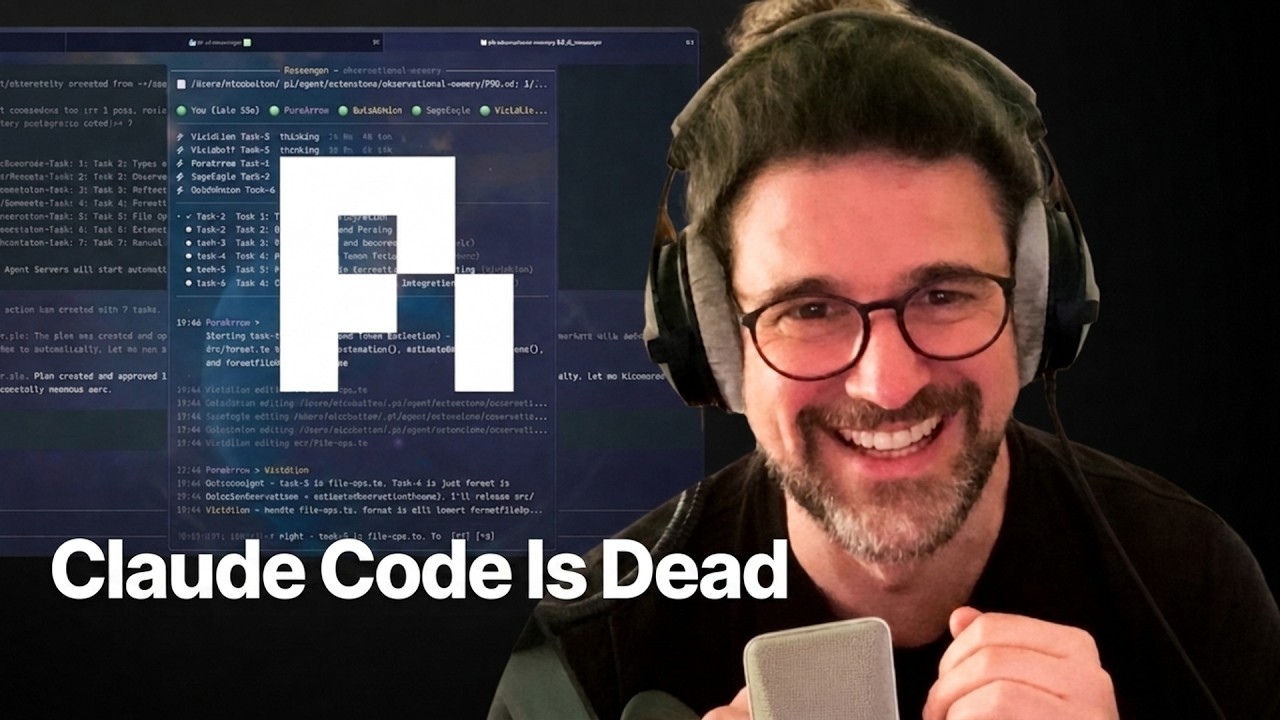
This shift is forcing a developer revolt against bloated commercial tools. Zechner built his own agent, Pi, to escape the instability of mainstream products like Claude Code, which he claims suffer from feature creep and performance degradation. This has ignited a “harness war,” discussed on Nerd Snipe, as developers fight for stable, controllable environments to orchestrate the underlying AI models.
The models themselves are becoming commodities. On This Week in AI, Matin Grinberg pointed to Chinese open-source models like DeepSeek V4, which deliver high-level intelligence at a fraction of the cost of GPT or Claude. This commoditization moves the competitive battleground from the model to the application layer. The new moat isn't a proprietary algorithm; it's the specific, reliable execution of a workflow.
"The value is shifting from the LLM to a deterministic agent that really encodes a specific institution's forward-deployed expertise."
- George Sivulka, This Week in AI
Enterprises are adapting quickly. Whittemore notes that corporate buyers are no longer focused on simple time savings. They are chasing entirely new capabilities. This agent-centric approach is fueling Anthropic’s growth, which now captures 70% of first-time enterprise AI buyers. The North Star is the zero-employee company, with startups like Pulsia reportedly hitting $6 million in revenue with a single founder directing an orchestra of agents.
The line between a senior architect and an engineering department is blurring into obsolescence. The game has changed.