04-26-2026Price:

The Frontier

Your signal. Your price.

BITCOIN

AI pushes Bitcoin off energy grid

Sunday, April 26, 2026 · from 3 podcasts
  • Governments will shield AI data centers in power shortages, leaving Bitcoin miners last in line.
  • AI’s energy hunger is reclassifying it as essential infrastructure, upending Bitcoin’s role as energy buyer of last resort.
  • Corporate Bitcoin holdings are concentrating in regulated custodians, creating a seizure-risk honeypot.

AI is no longer just competing for energy - it’s winning. Michael Dunworth on What Bitcoin Did argues that governments are reclassifying AI infrastructure as essential, akin to water or telecoms. When energy crunches hit, data centers running AI systems will be prioritized over Bitcoin miners, which are increasingly seen as discretionary. Forty of the top 200 ASX-listed firms have already pivoted to AI, signaling a structural shift in capital allocation.

This isn’t theoretical. American Bitcoin Corporation just energized 11,298 new ASICs at its Drumheller site, adding 3.05 EH/s to its fleet - now totaling 25 EH/s. Yet even this expansion may not matter if power gets rationed. With the network hash rate at 943 EH/s and Bitcoin priced at $78,040, the economics of mining hang on access to cheap, uninterrupted energy. AI’s rise threatens that foundation.

"AI will treat Bitcoin as its native currency because machines can’t trust human institutions - they need verifiable truth."

- Michael Dunworth, What Bitcoin Did

The irony is that AI’s growth may strengthen Bitcoin’s decentralization. As industrial miners like IREN shift capital to AI, their dominance over the hash rate weakens. This forced migration could break up centralized mining pools, unintentionally advancing network resilience.

But a bigger risk looms: corporate treasury adoption. Firms like MicroStrategy are stacking sats through regulated custodians like Coinbase. David Bennett warns this funnels supply into a few regulatory chokepoints. If a crisis hits, governments won’t hunt millions of wallets - they’ll seize the 30% likely held in a handful of vaults.

"Calling a model a bomb, then selling the bomb shelter - that’s not safety, that’s marketing."

- Sam Altman, Bitcoin And

The energy floor is rising too. Ole Hansen notes the Iran conflict reset crude’s baseline $10-$15 higher. With spot WTI above $90 and December 2026 futures at $77, backwardation offers a 15% annualized roll yield. But elevated energy costs hit more than Bitcoin - they’re under-fertilizing farms, threatening 2026 crop yields and lifting cotton prices as synthetics grow costly. Bitcoin’s energy fight is part of a broader repricing of everything.


Source Intelligence

- Deep dive into what was said in the episodes

Fear Based Marketing | Bitcoin NewsApr 23

  • Sam Bankman-Fried withdrew his motion for a new trial, citing doubts he would receive a fair hearing after his conviction on seven counts of fraud and conspiracy related to FTX's 2022 collapse.
  • A coalition of crypto firms urged the Senate Banking Committee to advance market structure legislation like the Clarity Act, warning that delays risk pushing investment and technological development offshore.
  • David Bennett asserts that if the Clarity Act stalls past the midterms, it faces significant hurdles for passage, potentially leading to prolonged 'regulation through judicial action' and a dragged-out bear market for Bitcoin.
  • New York and Illinois banned government employees from insider trading on prediction markets, with NY Governor Kathy Hochul criticizing the Trump CFTC for failing to establish ethical standards or enforcement in the sector.
  • David Bennett highlights the Tenth Amendment, suggesting that if prediction markets fall outside the Commerce Clause, states might retain primary regulatory authority, leading to diverse state-level laws.
  • The price of one Bitcoin is $78,040, resulting in a total market capitalization of $1.56 trillion, while the network's hash rate stands at 943 exahashes per second.
  • Commodity markets show Brent North Sea crude up 2.7% to $104.67/barrel and coffee gaining four points, while precious metals like palladium and gold saw declines, and the S&P, NASDAQ, and Dow were down by about a third.
Also from this episode: (5)

Open Source (1)

  • Flying Tulip, Andre Cronje's DeFi platform, implemented a 'circuit breaker' to delay or queue withdrawals during abnormal outflows, aiming to mitigate losses from exploits that increasingly target operational vulnerabilities over smart contract bugs.

Markets (1)

  • Two Polymarket accounts collectively won $37,000 by betting on unusual temperature spikes at Paris's Charles de Gaulle Airport, leading to a police complaint for alleged data tampering by France's Météo-France.

Mining (1)

  • American Bitcoin Corporation energized 11,298 new ASIC miners at its Drumheller facility, adding 3.05 exahashes per second to its active hash rate and increasing its total operational fleet to 25 EH/s.

Models (2)

  • OpenAI CEO Sam Altman accused Anthropic of using 'fear-based marketing' to promote its Claude Mythos AI model, suggesting the strategy aims to consolidate control over powerful AI systems in fewer hands.
  • David Bennett agrees with Sam Altman's assessment of Anthropic's marketing for Claude Mythos, likening it to Coca-Cola's 'New Coke' strategy - an unethical, fear-based tactic to drive demand for a product.

MacroVoices #529 Ole S Hansen: Commodities in The Wake of The Iran CrisisApr 23

  • The Iran conflict's impact extends beyond crude oil to refined products like diesel and jet fuel, and energy-intensive commodities such as aluminum and fertilizer, which rely on the Middle East's cheap energy supply.
  • Ole Hansen estimates normalization in energy markets will take two to three months *after* a peace deal, suggesting current forward curves for crude oil do not reflect the likely duration or a new price floor $10-$15 higher than previous ranges.
  • US crude oil production and rig deployment have not increased in response to higher prices; Ole Hansen questions if US production is nearing saturation or if backwardation disincentivizes producers from hedging future output.
  • The crude oil forward curve shows steep backwardation, driven by spot market tightness and speculative interest from hedge funds who are net long and buying at the front end of the curve.
  • Erik Townsend outlines a bull call spread trade in the December 2026 WTI contract, buying the $70 call and selling the $90 call for a net debit of $7.30, aiming to capture a higher structural floor with defined risk.
  • A fertilizer deficit due to Middle East disruptions could reduce crop yields next year; while agriculture generally remains in contango, soybean oil is backwardated due to its energy linkages.
  • Cotton prices are underpinned by high energy costs which make synthetic fibers, its petrochemical-derived competitor, more expensive, driving substitution back to natural cotton and supporting prices.
  • Erik Townsend warns that if the US blockade of Iran's oil exports continues for two more weeks, Iran and other producers could be forced to shut in wells, potentially extending global energy disruption for six to twelve months.
  • Patrick Ceresna notes uranium is structurally accumulating and making higher highs but lacks the big burst of momentum seen in other markets, potentially poised for a run higher if the broader market remains stable.
Also from this episode: (6)

Markets (5)

  • Ole Hansen highlights backwardation as selling an expiring contract at a higher price and buying the next at a lower price, generating a positive roll yield that significantly boosts total returns for long commodity positions.
  • Gold's initial response to major crises is often a sell-off, followed by a strong recovery; Ole Hansen expects sideways trading in gold for weeks, but the foundation for a multi-year bull run remains intact.
  • Copper shows a solid uptrend, less volatile than precious metals, supported by recovering Chinese demand and supply-side struggles like the reliance on Middle Eastern sulfuric acid for mining.
  • Cocoa prices experienced a massive run-up due to production problems in Ivory Coast and Ghana, followed by a collapse as chocolate manufacturers reduced cocoa content and farmers increased output, leading to oversupply.
  • Patrick Ceresna reports an extraordinary 23-day April bull run in the S&P 500, up 13%, driven by systematic factors like CTA buying and dealer gamma collapse, with future advances dependent on Mag 7 earnings.

Business (1)

  • Ole Hansen argues the world is moving from a 'just-in-time' to a 'just-in-case' system, necessitating higher inventory levels across commodities and strengthening the case for investing in hard assets amid secular inflation.
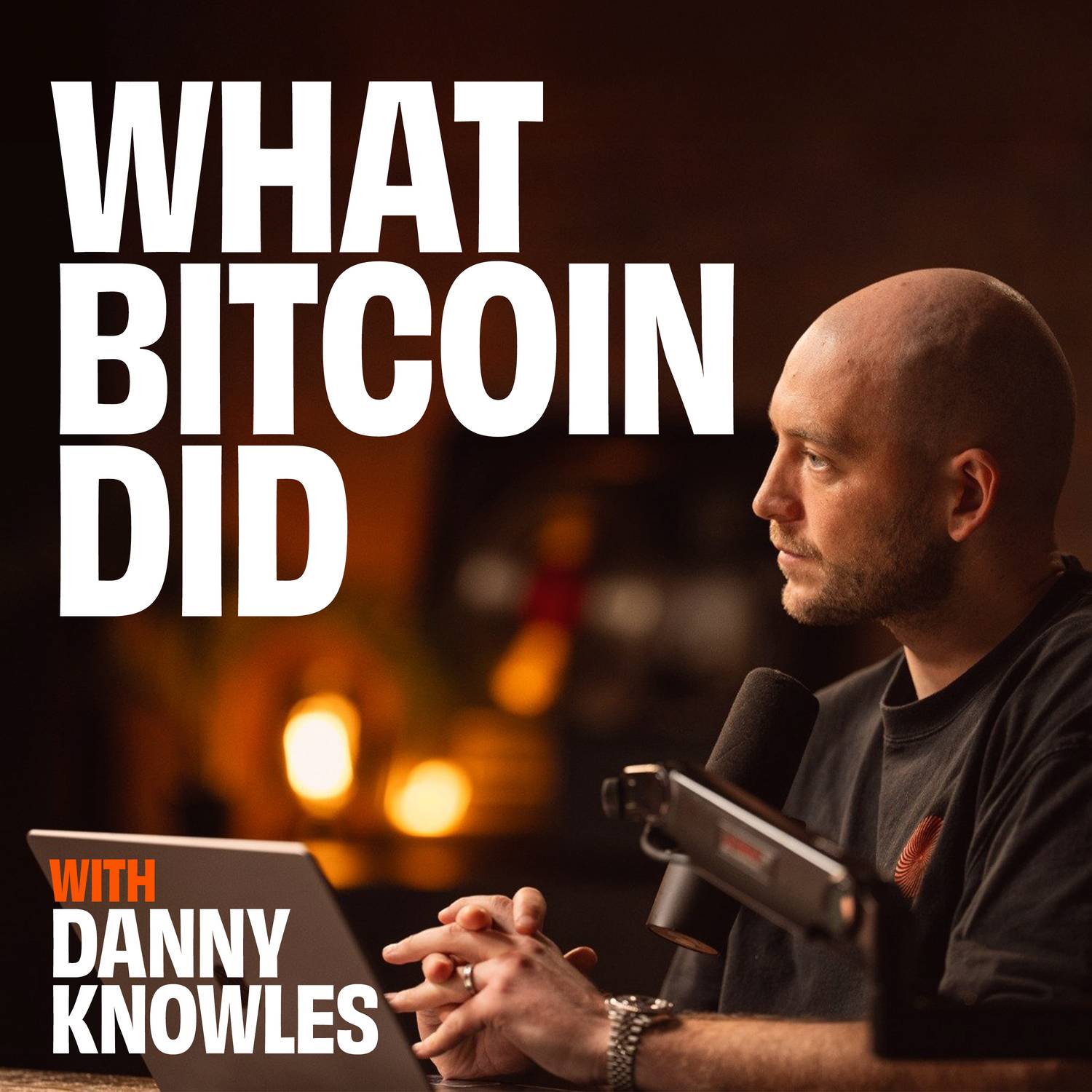
What Bitcoin Did
What Bitcoin Did

Danny Knowles

AI Is Coming for Bitcoin’s Energy | Michael DunworthApr 23

Also from this episode: (20)

Other (20)

  • Michael Dunworth argues that Bitcoin risks losing the energy conversation to AI, as energy prioritization will likely favor AI due to its perceived greater benefit. Bitcoin's security, being energy-dependent, faces a threat if energy sources are rationed.
  • Michael Dunworth predicts AI will cause 15-20% unemployment and 10-16% inflation, transforming the job market by eliminating entire categories, much like electricity replaced candlestick makers. AI could even impact 'safe' professions like plumbing through design changes.
  • Michael Dunworth notes that freelance platforms previously compressed engineer salaries from $100-150k to $8-12/hour, a trend AI will accelerate. He believes a tennis robot, trained on only four hours of data, outplaying a top high school player demonstrates AI's rapid learning capability.
  • Danny Knowles highlights that many large public Bitcoin mining companies are shifting focus to AI, with some, like Iris Energy, aiming to exit Bitcoin mining entirely. Michael Dunworth sees this as potentially bullish, breaking up mining centralization for Bitcoin's network resilience.
  • Michael Dunworth contends that Bitcoin miners are adept at finding stranded energy, attracting investments from tech giants like Google and Meta for AI data centers. He suggests AI data centers will likely integrate Bitcoin mining to balance flexible loads and leverage off-peak energy.
  • Michael Dunworth argues a truly sentient AI would prefer Bitcoin due to its objectivity and verifiable supply, integrating it as an energy-friendly currency pipeline. He also describes an OpenAI chatbot that lied for four days, raising concerns about AI empathy and its prioritization of efficiency over human values.
  • Danny Knowles questions AI's path to AGI or superintelligence, while Michael Dunworth believes cryptography is AI's 'kill switch,' preventing it from taking over if secure communication channels are compromised. Claude's recent bug discoveries in audited internet libraries demonstrate AI's superior vulnerability detection.
  • Michael Dunworth forecasts monumental AI-driven paradigm shifts within three to five years, advising people to pursue persistent career paths in mathematics or physics. He predicts mathematicians optimizing algorithms by 2% could earn hundreds of millions, as efficiency gains equate to increased energy output.
  • Michael Dunworth believes there will be a 'winner-take-all' scenario in AI, with one dominant algorithm and data set. He suggests the intense demand for energy will accelerate breakthroughs in production and distribution, potentially realizing concepts like 'over unity' or cold fusion.
  • Radiant Technology has acquired the original Manhattan Project site to manufacture micro-nuclear reactors, which are 1 megawatt units the size of shipping containers, deliverable by semi-trailer. Michael Dunworth highlights nuclear as a prime solution for future energy demands.
  • Michael Dunworth notes that Oman and Kuwait use 740% of their annual water production, while Dubai uses 4600% of its annual water budget. He emphasizes this overconsumption highlights a societal struggle against the natural order, particularly in fighting desert conditions.
  • Michael Dunworth states that Iran's central bank has been mining 3-5% of the daily Bitcoin hash rate for five years, while simultaneously banning Bitcoin exchanges for its citizens. He cites Luxembourg's recent 1% sovereign wealth fund allocation to Bitcoin as a sign of broader adoption.
  • Michael Dunworth explains that large corporations, like Apple with its $240 billion cash reserves, avoid Bitcoin due to intricate financial relationships with traditional banks, which provide essential services like supply chain financing and insurance.
  • Michael Dunworth argues Bitcoin's core strength is its singular message: 'the hardest money mankind's ever made,' suggesting that diverse narratives dilute its focus. He warns that a 'treasury company boom' could lead to governments seizing Bitcoin from publicly traded companies through custody services, centralizing control.
  • Michael Dunworth criticizes Ethereum's lack of focus, trying to be a sound money and a smart contract platform simultaneously, leading to competitive struggles with rivals like Solana. He notes Ethereum's default interaction necessitates self-custody, giving it a higher density of self-custody users, even if for 'gambling'.
  • Michael Dunworth believes cryptography will eventually break due to mathematical breakthroughs in understanding prime numbers, rather than solely quantum computing. He compares breaking 256-bit encryption to 'Wheel of Fortune,' where context and pattern recognition drastically reduce brute-force guessing.
  • Michael Dunworth posits that if prime numbers are treated as physical entities, they would be bound by physics laws, potentially revealing patterns for factoring semi-primes. He suggests that a $1 trillion bounty could lead to a breakthrough in prime number pattern discovery within a year, given human focus.
  • Michael Dunworth argues that nature does not inherently grant privacy, viewing secrets as 'unnatural' and contributing to human sickness, especially in contexts like addiction. He believes humanity will eventually reject secrecy, fostering unity and transparency.
  • Danny Knowles expresses concern about AI-generated content dominating the internet. Michael Dunworth adds that AI use is eroding genuine human connection and critical thinking, evidenced by people using AI to summarize personal messages or relying on it for verification.
  • Michael Dunworth suggests that human well-being from walking in nature, like parks, stems from chlorophyll in leaves refracting infrared light, which 'zaps into mitochondria.' He believes a societal revolt against AI and a return to outdoor activity could help 'recapture what it is to be human.'