03-16-2026Price:

The Frontier

Your signal. Your price.

POLITICS

Trump's Iran Bluster Masks a Failing War Strategy

Monday, March 16, 2026 · from 2 podcasts, 3 episodes
  • Trump’s resurrected 1988 threat to seize an Iranian oil island is now a desperate talking point as his strategic objective - controlling the Strait of Hormuz - collapses.
  • Pentagon officials frame U.S. naval inaction at the strait as deliberate 'shaping operations,' a narrative contradicted by Iran’s control of the waterway and direct negotiations from world powers.
  • Media and political figures increasingly recycle the cliché 'short-term pain for long-term gain' to justify a war where the U.S. shows military restraint and strategic weakness.

Trump’s foreign policy is trapped in a decades-old threat. A 1988 newspaper quote where he vowed to 'take' Iran's Karg Island has resurfaced as a media cudgel during the current conflict. On Fox News, Trump dismissed the question as foolish, but the rehash highlights how his bravado now masks a failing strategy.

The Quincy Institute’s Trita Parsi, speaking on Breaking Points, argues Trump is in the desperation phase. The president claimed victory over Iran’s military, then begged other nations to send warships to help reopen the Strait of Hormuz. Iran, not the U.S., controls the critical waterway. Major economies like India and France are now negotiating directly with Tehran for safe passage, a clear sign of Washington’s diminished leverage.

At home, the administration sells this weakness as strength. Pentagon spokesperson Pete Hegseth celebrated high-volume strikes while admitting the Navy will not escort commercial tankers through the strait. He framed this inaction as calculated 'shaping operations.' This narrative clashes with video of Iranian leaders openly marching in Tehran and analysis that the regime’s deep power structure is resilient to decapitation strikes.

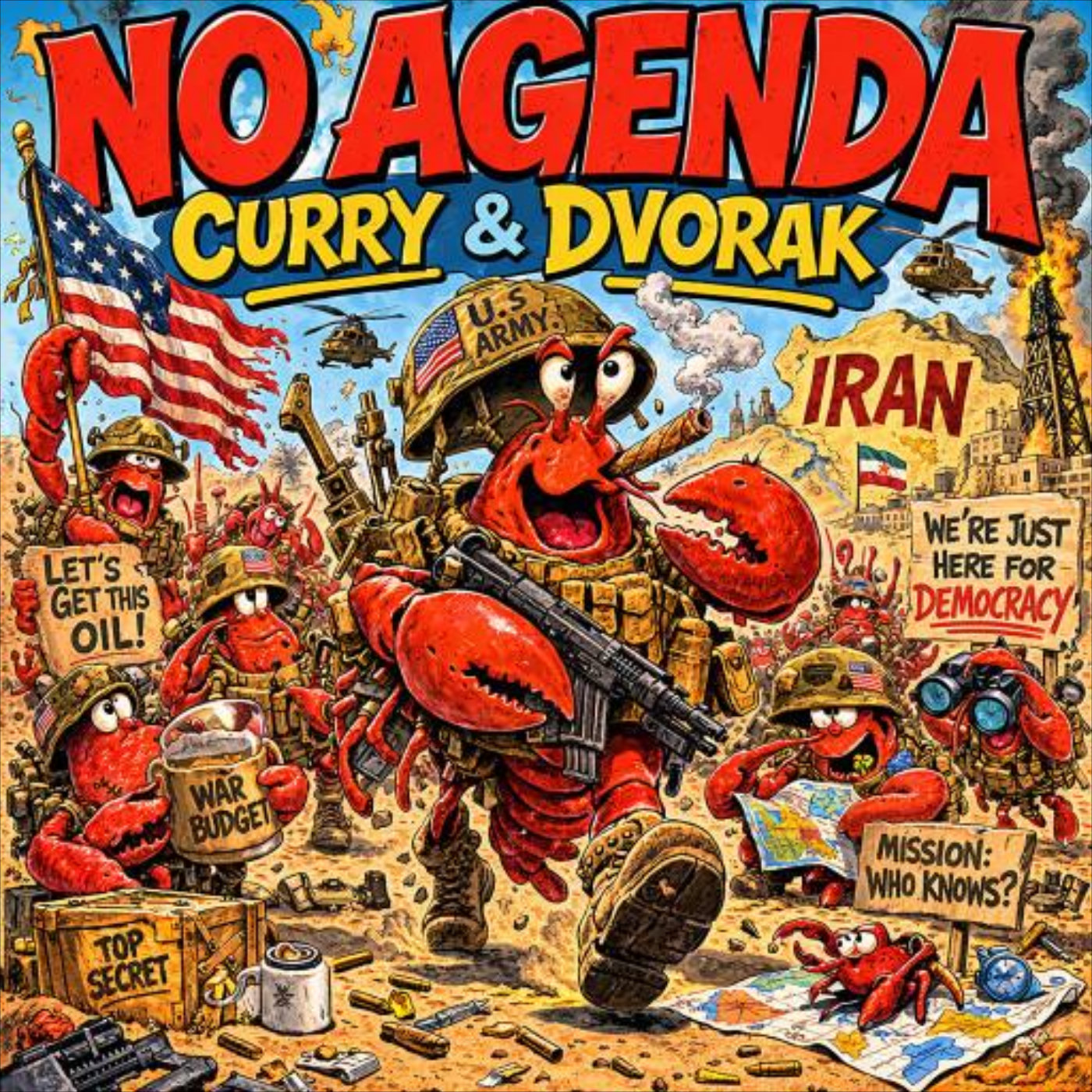
Media coverage is filled with the justifying mantra of 'short-term pain for long-term gain,' a political cliché dissected on the No Agenda Show. The phrase papers over the reality of a constrained U.S. military posture and a president who appears boxed in by the catastrophic economic risks of full escalation.

The bluster about bombing islands and hiding rats is the sound of a war that cannot be won on its original terms. The real shaping operation is happening in Tehran, where Iran holds the cards, and in global capitals, where leaders are cutting their own deals.

Trita Parsi, Breaking Points:

- You're seeing the words of a man who actually has been defeated and who knows it.

- This is the desperation phase of this war at this point.
Entities Mentioned

Fox NewsCompany

Source Intelligence

What each podcast actually said

1851 - "Mork & Mimi"Mar 15

  • A 1988 interview in which Donald Trump threatened to seize Iran's Karg Island, its primary oil export hub, has resurfaced in media coverage of the 2026 U.S.-Iran conflict.
  • Fox News host Brian Kilmeade confronted Trump with the decades-old threat on air, a clip analyzed by the No Agenda Show.
  • Trump dismissed Kilmeade's question as foolish, rhetorically asking what fool would answer whether he would still seize the island.
  • Trump pivoted from the Iran question to boasting about his prescient 2000 call to kill Osama bin Laden, which he claims was ignored until after 9/11.
  • Adam Curry and Mimi Smith-Dvorak deconstructed war coverage, including a U.S. tanker crash in Iraq, rising oil prices, and the easing of Russian oil sanctions.
  • The No Agenda Show highlighted a supercut of politicians and pundits repetitively using the phrase 'short-term pain for long-term gain' to justify the conflict's economic and human costs.
  • The hosts critiqued media factual sloppiness with a segment on the misidentification of a historic California bar, the Hotsy Totsy Club.
  • Co-host John C. Dvorak is recovering from heart surgery; Adam Curry reported Dvorak sounded unusually upbeat during a hospital call and is expected to be released soon.

3/14/26: TRUMP KNOWS HE’S DEFEATED! Begs Other Countries to Rescue USMar 14

  • Trita Parsi of the Quincy Institute argues Trump is in a 'desperation phase' of the Iran conflict, where his contradictory rhetoric reveals a leader who knows the U.S. strategic objective of controlling the Strait of Hormuz has been defeated.
  • Parsi claims Iran holds decisive leverage because its operational control over the Strait of Hormuz has forced major economies like India and France to negotiate safe passage directly with Tehran, bypassing Washington.
  • According to Parsi, Iran's ability to dictate terms to global powers represents a significant shift, granting Tehran more leverage than it has had in decades, which it is unlikely to surrender without major concessions.
  • Trump's constrained military strikes, which hit Iranian military targets on Karg Island but spared its oil infrastructure, are interpreted by Parsi as a forced pullback and a clear sign of weakness to Tehran.
  • Parsi speculates Trump's restraint was likely due to internal warnings that escalating against Iran's oil infrastructure would trigger a 'suicidal' global economic contraction.
  • The economic shock from the conflict is already global, with Asian nations curtailing school and work days due to fuel shortages, a situation Parsi's colleague warns could escalate into a COVID-scale economic contraction.
  • Leaks from U.S. military officials to the Wall Street Journal, criticizing a president who ignored warnings Iran would close the strait, reveal an administration trying to distance itself from a failed strategy.

3/13/26: US Plane Crash In Iraq, Michigan Attack, Munitions Deplete, Brad Lander Joins & MORE!Mar 13

  • Pentagon spokesperson Pete Hegseth framed the U.S. Navy's refusal to escort commercial oil tankers through the blockaded Strait of Hormuz as a deliberate strategic choice, calling it 'shaping operations.'
  • Hegseth claimed the U.S. was executing 'the highest volume of strikes' over Iran while simultaneously boasting about an unfair fight against the Iranian military.
  • Hegseth described Iranian leaders as 'hiding like rats,' a characterization contradicted by footage aired on Breaking Points showing President Ebrahim Raisi marching unprotected through Tehran streets near an Israeli strike.
  • Commentator Ryan Grim argued the U.S. strategy of targeting leaders is a strategic blindness, as Iran has a deep, horizontal power structure with a pre-planned succession chain six or seven people deep.
  • Grim compared the U.S. focus on decapitation strikes to Iran assassinating a U.S. governor and declaring mission accomplished, suggesting the regime is far more resilient than the 'kill the bad guy' narrative allows.
  • The Pentagon's triumphalist rhetoric about strikes and shaping operations obscures the material failure of the world's most powerful navy ceding control of the critical global oil chokepoint at the Strait of Hormuz.
  • Krystal and Saagar analyzed that the 'shaping' appears primarily focused on shaping a public narrative of control and deliberate sequencing, rather than achieving a tangible strategic objective on the ground.
