Price:

POLITICS

Secret Service claims success as shooter's manifesto details zero security

Wednesday, April 29, 2026 · from 4 podcasts, 5 episodes
  • The Secret Service calls the WHCD shooting a ‘success story’ while the shooter’s manifesto describes a completely unsecured venue.
  • Agency leadership faces a credibility crisis, with internal purges and political showmanship eroding its operational core.
  • Trump uses the breach to demand an end to lawsuits blocking a fortified White House ballroom.

The White House Correspondents’ Dinner became a brutal audit of the Secret Service. While Acting Attorney General Todd Blanche labeled the event a “massive security success story,” shooter Cole Allen’s manifesto painted the opposite picture. On Breaking Points, Saagar Enjeti rejected the official framing, citing multiple witnesses who entered the Washington Hilton without showing ID or passing through a magnetometer. Former official Simone Sanders walked past the presidential limo without a challenge. The hotel lobby remained open to the public.

“He was shocked that there were no guards. He wrote, ‘I was expecting agents every ten feet.’ He said an Iranian hit squad could have cleared that perimeter.”

- Joe Kent, Breaking Points

Cole Allen, a Caltech-educated teacher and former NASA intern, detailed the lax security in writings posted before the attack. He booked a room at the hotel in early April and brought weapons by train from California. On The Intelligence, host John Prideau argued that protecting a candidate in a country with half a billion civilian guns is a near-impossible task, but the breach happened long before shots were fired.

The failure points to a deeper institutional rot. The Daily’s reporting reveals an FBI under Director Kash Patel that prioritizes social media optics over investigative integrity. Agents describe Patel filming “Rambo-like” videos at Quantico and hijacking briefings to script tweets. This culture of performance, where raids are staged for cameras, mirrors a broader decay in federal protective services where image outweighs substance.

Political leadership is exploiting the crisis. Donald Trump immediately used the shooting to argue for his “drone-proof” White House ballroom, urging critics to drop a lawsuit delaying its construction. The Intelligence noted this is a characteristic move for a candidate who turns security threats into arguments for isolation.

“The security failure was undeniable: the shooter’s own manifesto boasted that he only had to flash a ticket to get into the lobby.”

- John Prideau, The Intelligence

Public trust has evaporated. With the FBI’s mission drifting toward immigration theatrics and political purges, and the Secret Service unable to secure a high-profile hotel, the agencies built to ensure stability are now sources of profound vulnerability. The shooter was a radicalized centrist, not a fringe extremist, signaling that distrust now permeates the educated mainstream. When the state’s own accounts defy the evidence on the ground, conspiracy theories become the public’s default explanation.

Source Intelligence

- Deep dive into what was said in the episodes

4/27/26: WHCD Shooting Conspiracies, Joe Kent On Secret Service Failures & IranApr 27

  • Krystal and Saagar argue that distrust in official narratives about the White House Correspondents' Dinner shooting is fueled by government failures, previous security lapses, and a culture of official secrecy that mirrors the 1970s.
  • Joe Kent, former National Counter Terrorism Director, says there have been three breaches of President Trump's security perimeter since he returned to the campaign trail. He claims the DHS Inspector General was blocked from investigating the Butler shooting by top DHS leadership.
  • The shooter, Cole Allen, was a Caltech graduate and former NASA intern whose LinkedIn shows he interned at NASA in 2014. A strange X account under the name Henry Martinez, with a Pepe the Frog avatar, made a single post on December 21, 2023, saying 'Cole Allen'.
  • Two weeks before the dinner shooting, the Secret Service investigated but could not solve a mystery shooting near the White House in Lafayette Park, finding only rifle shell casings at 16th and I Streets.
  • The Trump administration provided a lower level of security for the White House Correspondents' Dinner despite the presence of the President and many cabinet members, creating a massive single point of failure in the line of succession.
  • Joe Kent argues the White House has a 'zero-fail' culture that discourages critical after-action reviews and prevents officials from telling the President 'we can't do that' for security reasons.
  • On the Iran war, Joe Kent advises Trump to declare victory and withdraw, citing Reagan's 1984 Lebanon pullout as a model. He warns that maintaining the blockade risks Iranian retaliation and a prolonged escalation cycle the US cannot win.
  • Saagar notes weird details fueling conspiracy theories, including Press Secretary Caroline Levitt saying 'there will be some shots fired' before the event and her husband giving a serious safety warning to a reporter just before the shooting.
  • The Department of Justice has cited the dinner attack in a letter to push for the construction of a $400 million White House ballroom, after a judge had temporarily blocked the project.
Also from this episode: (1)

Politics (1)

  • Kent says continued US presence in the Gulf is a strategic liability, has shattered the illusion of American security guarantees, and is pushing Gulf states to move away from the petrodollar, threatening the US reserve currency status.

4/26/26: WHAT WE KNOW: WHCD Shooter NAMED, Security FAILUREApr 26

Also from this episode: (9)

Politics (5)

  • A shooting occurred at the Washington Hilton during the White House Correspondents' Dinner, requiring the President, Vice President, and senior officials to be rushed off stage.
  • The Deputy Attorney General, Todd Blanche, controversially labeled the incident a "massive security success story," arguing the suspect barely breached the perimeter.
  • Multiple witnesses, including Simone Sanders, reported a significant lack of standard security protocols, such as un-barricaded driveways, absent ID checks, and an unsecured hotel lobby.
  • Congressman Mike Lawler criticized the security, noting no photo ID requirements, unverified attendee lists, and no magnetometers before the ballroom, despite Secret Service acting swiftly.
  • President Trump linked the shooting to the need for a large, secure ballroom on White House grounds, which he claims is under construction and faces a lawsuit from a dog walker.

Society (2)

  • The gunman, Cole Allen, used a makeshift shotgun and also possessed a handgun and knives. One Secret Service agent was hit in a bulletproof vest and transported to the hospital, remaining unharmed.
  • Allen traveled from Los Angeles to D.C. via train, passing through Chicago, and booked a room at the Washington Hilton in April, checking in with weapons in his luggage.

Education (1)

  • Cole Allen, 31, from Torrance, California, is a Caltech mechanical engineering graduate and former NASA JPL intern. He donated $25 to Act Blue in 2024 for "Harris for President."

History (1)

  • The Washington Hilton was also the site of President Reagan's 1981 assassination attempt, adding a surreal and shocking dimension to this recent security incident.

Security banquet: queries over Trump protectionApr 27

  • Germany's Bundeswehr is undergoing a generational rearmament, known as the 'Zeitenwende,' significantly increasing public visibility for figures like General Karsten Breuer and leading to a new national military strategy.
  • Germany's defense budget exceeds 100 billion euros this year, with plans to reach 160 billion euros by 2029, and committed to NATO's 3.5% of GDP defense spending target six years ahead of schedule.
  • General Karsten Breuer acknowledges the need to replenish existing military systems after years of underfunding but seeks to adopt Ukraine's rapid innovation cycles for new weaponry and technology in Germany.
  • Germany faces challenges in military procurement efficiency and increasing active soldier numbers from just over 180,000 to a NATO-mandated 260,000 by 2035, likely requiring the reintroduction of conscription.
  • The German rearmament effort is partially driven by concerns that the US security guarantee, particularly under a potential Donald Trump presidency, cannot be relied upon, making Russia Europe's main adversary.
Also from this episode: (9)

Politics (4)

  • A gunman attempted to breach security at the White House Correspondents' Dinner, injuring a Secret Service agent and prompting Donald Trump and Vice President J.D. Vance to be rushed away.
  • John Priddo described the incident as a massive security failure, noting the gunman's manifesto boasted about lax security, but also highlighted the Secret Service's challenging role in a country with approximately half a billion civilian guns.
  • Donald Trump framed the assassination attempt, the third on his life, as justification for a new, highly secure White House ballroom, describing it as drone-proof and bulletproof.
  • Despite a common perception of rising political violence, John Priddo suggests actual political violence is lower than in the 1960s and 1970s, though media coverage makes it feel more pervasive.

Society (3)

  • The 'Passport Bros' movement involves Western men traveling abroad for dating, seeking women in countries where their money and social status provide an advantage, often desiring traditional gender roles.
  • Listeners suggest the Passport Bros phenomenon stems from socioeconomic challenges faced by young men in the West, with remote work enabling them to leverage higher earning currencies in lower-cost countries.
  • Historian Beth Bailey notes that people seeking to establish their own rules, as seen with Passport Bros, is a common trend during times of economic uncertainty.

Psychology (2)

  • Carla Subudana's reporting on Passport Bros found men seeking partners who facilitate traditional roles, sometimes specifying poorer women to more easily assert dominance within relationships.
  • While women also travel abroad for dating, Carla Subudana observes the Passport Bros movement is distinct in its unified social media narrative that frequently blames Western women for not being 'feminine' or 'accommodating' enough.
No Agenda Show
No Agenda Show

Adam Curry

1863 - "Nekkidly"Apr 26

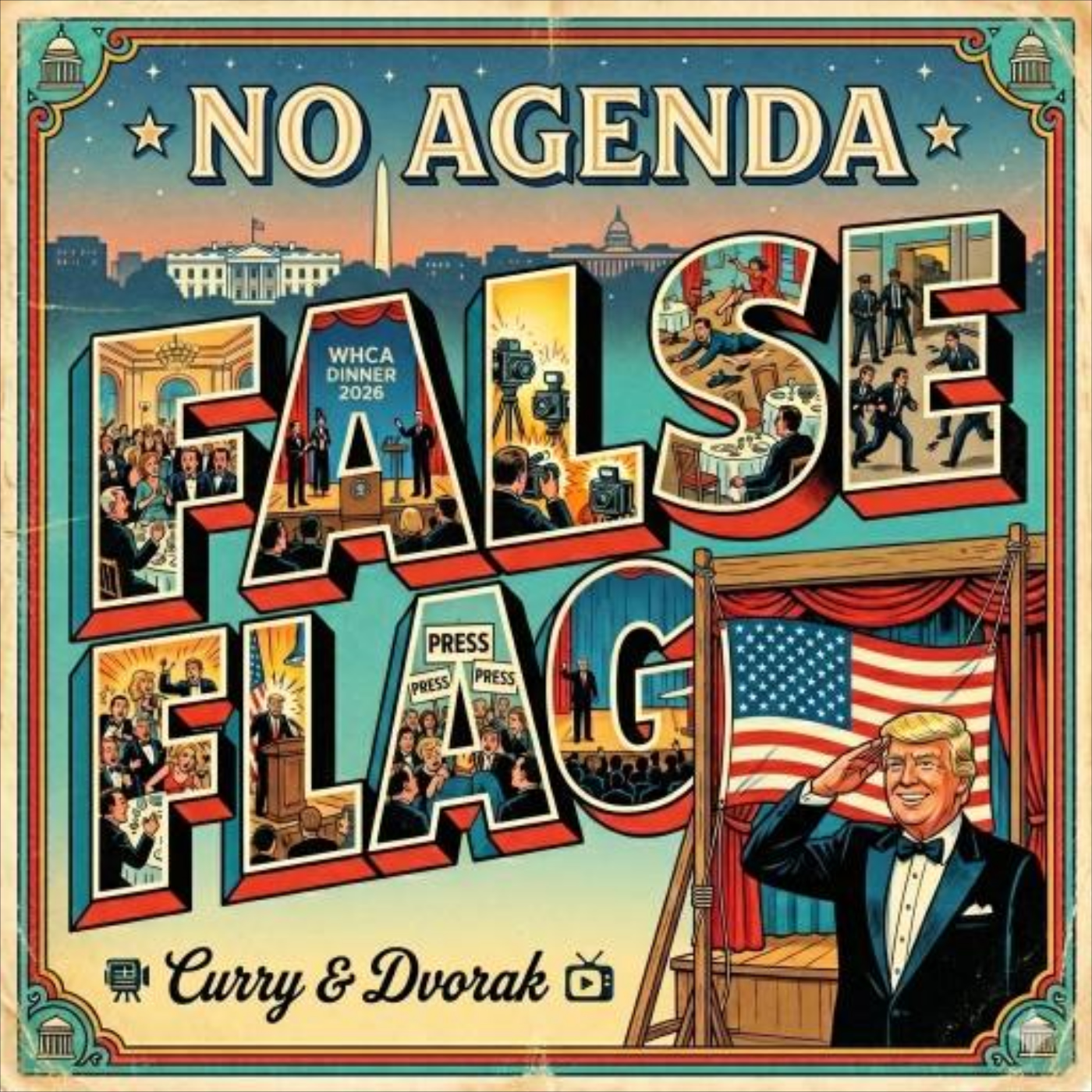
  • Adam Curry and John C. DeVorex hosted "No Agenda" Episode 1863 on Sunday, April 26, 2026. John C. DeVorex noted widespread "false flag" claims regarding an unspecified event.
  • Over 200 journalists signed a letter demanding that Donald Trump be challenged on press freedom at the White House Correspondents' Dinner, which also featured a mentalist instead of a comedian during his last attendance.
  • Margaret Brennan linked an alleged shooting at the dinner to the Second Amendment, citing 564 threats against judges and nearly 15,000 against lawmakers last year.
  • A 31-year-old alleged shooter, identified as Allen, traveled by train from Southern California with multiple weapons, including a shotgun, handgun, and knives, and shot a Secret Service officer in body armor.
  • Chris Cuomo defended the SPLC, noting its historical cooperation with federal law enforcement against hate groups, a relationship he claimed the Justice Department recently terminated.
  • Pfizer's post-marketing report noted over 1,200 suspected deaths within two months of Comirnaty's approval; a Paul Ehrlich Institute report identified 2,133, suggesting an actual 60,000 deaths in Germany with a 30x underreporting factor.
  • The Pfizer toxicologist stated that Comirnaty was not tested for preventing severe illness or death, invalidating the courts' assumption of a "positive risk-benefit ratio." Mortality in Germany rose significantly from 2021 to 2022.
  • Dr. Eric Berg highlighted that a 2007 law mandating drug study results be posted, with a $13,000 daily fine for non-compliance, has led to zero FDA fines in 19 years, totaling $19 billion owed by pharma.
  • British commentators viewed King Charles's U.S. visit as an "embarrassment" due to Donald Trump's past insults towards British troops, NATO, and the Royal Navy, despite its purpose as a "soft power" diplomatic effort.
  • A leaked Pentagon memo reportedly considered sanctions against NATO allies, including reviewing Britain's ownership of the Falklands, for not supporting the U.S. in the Iran war.
  • Argentina is rearming with F-16 jets from Denmark, supported by U.S. missiles, raising concerns for the UK's ability to defend the Falklands, given its limited military footprint there.
  • A 1974 Mike Wallace interview with the Shah of Iran suggested the 1970s oil crisis was a "fraud" orchestrated by oil companies diverting supply for profit, rather than a genuine shortage.
  • The book "The Men Who Run the World" describes commodity traders like Mark Rich who profited immensely from the Suez Canal closure and engaged in secretive oil flows, later being indicted for tax fraud and pardoned by President Clinton.
  • Shadowy traders operating from Dubai are rebranding sanctioned Russian, Iranian, and Venezuelan oil as Malaysian to bypass sanctions, a tactic that political scientists cite as a reason for sanctions' failure.
  • Manosphere podcasters are turning on Donald Trump, criticizing his unfulfilled promises on deportations, Epstein files, and gasoline prices, a shift CNN and MSNBC suggest could undermine his public image.
Also from this episode: (11)

Media (2)

  • During an interview about a reported false flag at the White House Correspondents' Dinner, Fox News allegedly cut off Aisha Hasni as she was about to reveal critical information.
  • Adam Curry emphasized that "No Agenda" provides analysis, not support, aiming to offer alternative perspectives by questioning mainstream narratives, a strategy he believes strengthens listener's beliefs or prompts questioning.

Politics (3)

  • The shooter's LinkedIn manifesto targeted "pedophile rapist and traitor" Trump administration officials, specifically excluding a "Mr. Patel." His brother had previously alerted local police to alarming writings.
  • Dame Rhonda described how an SPLC lawsuit, *Ricky Wyatt v. Alabama Department of Mental Health*, led to such high standards that Alabama and other states defunded mental health care.
  • John Stossel's 2017 report on the SPLC criticized its practice of labeling critics of radical Islam as "anti-Muslim extremists" and highlighted its growing endowment, then over $320 million.

AI & Tech (4)

  • Alex Jones claimed "globalist mad scientists" created an "intergalactic communication system," a term J.C.R. Licklider used in the 1960s to envision the internet as a nuclear-attack-resilient, distributed network.
  • John C. DeVorex is optimistic Apple's integrated chips and universal memory in devices like the Mac Mini and Mac Studio position them well for local AI model inference, unlike competitors who cram phones with "AI garbage."
  • Anthropic has substantially increased Claude AI service costs, with monthly subscriptions reaching $200 and additional credits costing $2 every 30 seconds of usage, suggesting an IPO strategy.
  • Florida's Attorney General, James Uthmeyer, opened a criminal investigation into OpenAI after an FSU shooter allegedly consulted ChatGPT over 200 times for planning advice.

Business (1)

  • John C. DeVorex asserted that Enron, during its bandwidth trading, undermined the internet's original peering system by introducing charges, contributing to its eventual centralization.

Science (1)

  • A former Pfizer Europe chief toxicologist testified in Germany that the Comirnaty vaccine's carcinogenicity and reproductive effects were not adequately tested before fast-track approval.

Inside Kash Patel’s F.B.I.Apr 22

  • Emily Bazelon explained that the FBI's post-Watergate tradition of political independence shifted under Donald Trump, who publicly labeled the Bureau as corrupt.
  • Tanya Ugoritz was targeted in a political purge after an email wrongly linked her to withdrawing a 2020 FBI intelligence report about alleged Chinese fake IDs in the 2020 election.
  • Despite an internal review finding no misconduct, Tanya Ugoritz was demoted and transferred, prompting her departure from the FBI after being told her senior executive position was at Kash Patel's discretion.
  • Senator Chuck Grassley, chair of the Senate Judiciary Committee, sought internal FBI documents related to "suspect, bad things" the agency allegedly did during the Biden administration.
  • Blair Tolman, a supervisory special agent in the CR-15 public corruption unit, was fired after investigating President Trump's alleged 2020 election interference, understood as retaliation for her work.
  • Emily Bazelon and Rachel Poser found a "culture of fear" within the FBI due to numerous firings, leading agents to avoid politically sensitive assignments and potentially compromising national safety.
  • Blair Tolman is a lead plaintiff in a lawsuit challenging dismissals under Kash Patel as a "political purge," seeking reinstatement and due process for affected FBI employees.
  • Many FBI employees, perceiving internal checks as failing, spoke to the media as a last resort, concerned that the agency's mission of keeping Americans safe was severely compromised.
  • Rachel Poser and Emily Bazelon concluded that under Kash Patel, the FBI was "turned upside down," with significant turmoil that could compromise national safety by overlooking key threats.
  • President Trump extended a ceasefire with Iran after Vice President J.D. Vance delayed his Pakistan trip, departing from an earlier public threat to bomb Iran.
  • Virginia voters approved a gerrymandering plan to favor Democrats in congressional districts, potentially eliminating four of the state's five Republican-held seats before upcoming midterms.
Also from this episode: (12)

Politics (10)

  • Rachel Poser and Emily Bazelon interviewed 45 current and former FBI employees, reporting an agency under strain from political pressure, with partisan leadership and alienated agents.
  • Kash Patel's appointment as FBI director was unusual, given his limited federal law enforcement experience and his history of promoting conspiracy theories about the Bureau and January 6th.
  • Tanya Ugoritz noted Kash Patel's initial order to abruptly move hundreds of FBI field agents from Washington, perceiving it as an arbitrary decision lacking understanding of headquarters operations.
  • John Sullivan's optimism for FBI leadership ended with the selection of Dan Bongino as Deputy Director, a pro-Trump podcaster known for advocating to disband the Bureau.
  • Kash Patel and Dan Bongino prioritized the FBI's public image, with Patel filming "Rambo-like" videos at Quantico, influenced by President Trump's desire for specific optics from operations.
  • Emily Bazelon reported that during the Charlie Kirk investigation, Kash Patel took control of executive calls, scripting social media strategy, which led to mistakes and compromised agent safety during raids.
  • Kash Patel caused a minor international incident by attempting to post a restricted photo from a secret intelligence conference at Windsor Castle, prioritizing social media over discretion.
  • Rachel Poser explained the Trump administration's immigration focus redirected FBI resources, reassigning analysts like Jill Fields from core duties such as terrorism and cybercrime to immigration enforcement.
  • Jill Fields refused an order to open an investigation into anti-ICE protesters, whose actions were First Amendment-protected, despite pressure originating from top FBI leadership.
  • Jill Fields was told she would be fired if she refused orders to investigate First Amendment-protected activity, leading to her reassignment, monitoring, and eventual departure from the FBI after 24 years.

Culture (1)

  • FBI spokesman Ben Williamson dismissed the reporting by Rachel Poser and Emily Bazelon as "fake narratives" from "anonymous sources," despite their story including multiple named sources.

Regulation (1)

  • Rachel Poser noted The Atlantic published an article accusing Kash Patel of excessive drinking, which led Patel to file a defamation lawsuit against the publication.