POLITICS
Trump's Strait of Hormuz gamble fails as Iran calls his bluff
- The U.S. cannot militarily reopen the Strait of Hormuz, with Iran holding the key to global oil flows and forcing India and Europe to negotiate directly with Tehran.
- The war justification is unraveling as a top Trump official resigns and says the strike was based on false Israeli intelligence about an imminent nuclear threat.
- The conflict is triggering a global energy catastrophe, with China facing a three-month oil countdown and U.S. allies refusing to join an unpopular war.
Entities Mentioned
Source Intelligence
What each podcast actually said

3/20/26: Bibi Demands Ground Troops, Hegseth Caught Lying, Iran War Master Plan w/ David Sirota • Mar 20
- Israeli Prime Minister Benjamin Netanyahu publicly stated a revolution in Iran cannot be done from the air, explicitly advocating for a US-led ground troop component in the conflict.
- Krystal Ball noted Netanyahu delivers a dual-track message, telling English-language audiences the conflict could end quickly while telling Israelis in Hebrew it will last as long as necessary, signaling a protracted commitment.
- Griffin argued the US strategy has unraveled after the administration overestimated Iran's restraint and the capability of internal anti-regime forces to capitalize on airstrikes, making ground intervention the only remaining escalation.
- The Strait of Hormuz is now an active combat zone, with US attack jets and Apache helicopters targeting Iranian naval assets and drones in an attempt to reopen the critical oil chokepoint.
- Krystal Ball framed the situation as a classic escalation trap, where the only politically untenable way for President Trump to end the war would be to walk away while making significant concessions to Iran.
- Reporting indicates the Trump administration is considering plans to occupy Iran’s Qeshm Island to force the Strait of Hormuz open, with Marines being rushed into the region.
3/19/26: Energy Infrastructure Burns, Trump Wants $200 Billion For War, Energy Prices Spike, Mearsheimer Exposes US Disaster • Mar 19
- U.S. and Israeli forces struck Iran's South Pars gas field, a pillar of Iran's domestic energy supply, representing a major escalation beyond tit-for-tat strikes.
- Iranian-backed forces retaliated by declaring all major oil and gas sites in Saudi Arabia, the UAE, and Qatar as legitimate targets and began striking them within hours.
- Qatar's Ras Laffan industrial city, the world's largest LNG export terminal accounting for 20% of global supply, suffered extensive damage, prompting Qatar to declare force majeure on numerous export contracts.
- The attack on Qatar's LNG terminal sent European natural gas prices surging 25% overnight, threatening a severe economic and energy crisis for Europe and Asia.
- Saudi Arabia's Yanbu refinery, a crucial node for the East-West Pipeline that bypasses the Strait of Hormuz, was struck in an attempt to cut off both of Saudi Arabia's remaining export routes.
- Saagar Enjeti argues the attacks represent a shift to an 'earth-shattering' strategy of mutual economic suffering, with the goal being to inflict massive damage on global energy infrastructure.
- The immediate consequence of the infrastructure attacks is a likely rush back to coal by Asian economies to meet energy demands, creating devastating climate implications.
- The U.S. remains temporarily insulated from the price shock due to domestic production, creating a divergence between global Brent crude prices and U.S. West Texas Intermediate crude.
3/19/26: Joe Kent Sounds Off On Tucker, Professor Pape On Incoming Iran Invasion • Mar 19
- Former National Counterterrorism Director Joe Kent publicly stated U.S. intelligence assessed Iran posed no imminent nuclear threat before the US-Israel strike, contradicting official White House and Pentagon claims.
- Kent claims the Iranian regime has had a religious ruling against developing nuclear weapons since 2004 and was pursuing a strategy of pragmatic deterrence, not imminent weaponization.
- Kent told Tucker Carlson that Israeli officials lied to President Trump about an Iranian nuclear threat to justify a preemptive attack, according to his Breaking Points interview.
- Kent describes a wall of pro-war advisors around President Trump who systematically shut out dissenting analysis about the lack of an Iranian nuclear threat.
- The FBI is now investigating Kent for allegedly leaking classified information, a move Krystal Ball and Saagar Enjeti call political retribution for his whistleblowing.
- Kent's account aligns with Tulsi Gabbard's Senate testimony that the intelligence community assessed Iran's nuclear enrichment program was 'obliterated' by last summer's airstrikes.
- Breaking Points hosts argue the official justification for the war is cracking under its own weight as contradictory accounts from officials like Kent emerge.
3/17/26: Top Iran Official Assassinated, WH Panic Over DropSite Report, Yanis Varoufakis on Iran War • Mar 17
- Breaking Points host Saagar Enjeti argues the US-Israel strike that killed Iranian official Ali Larijani aims to foment revolution by decapitating Iran's security establishment, continuing an escalation pattern from strikes on Hezbollah and Hamas.
- Saagar Enjeti claims removing Larijani, who represented an independent power base, could backfire by consolidating control under the IRGC and new Ayatollah, making the hardline command more unified and aggressive.
- Krystal Ball notes Donald Trump believed closing the Strait of Hormuz would end conflict with Iran in four days, but Iran now effectively controls the strait and continues its own oil exports.
- Krystal Ball points out that Secretary of State Scott Bessett's posture, pretending to permit Iranian oil exports, underscores the fiction of US leverage and who truly holds power in the region.
- Krystal Ball argues Trump's attempt to build an international coalition against Iran is failing, with European allies refusing to join what they see as a US-created crisis.
- Breaking Points played a clip of Trump complaining that allies protected by US troops for decades are reluctant to join the Iran effort, with Argentina being the only confirmed partner so far.
- Saagar Enjeti states the US-Israeli strategy assumes the Iranian regime will crumble without its leaders, a premise that already failed when Trump targeted the previous Ayatollah expecting swift collapse.
- Saagar Enjeti claims Iran's system is designed so that even if top leadership is eliminated, the government can persist and continue governing, making decapitation strikes strategically flawed.
3/17/26: Trump Demands $100 Billion, Rachel Maddow Deranged Monologue, US World Order Collapse, Trump NatSec Resignation • Mar 17
- The White House and Pentagon are drafting a $100 billion supplemental funding request for the Iran war, reports Saagar Enjeti.
- Under reconciliation rules, the $100 billion request must be offset by equivalent cuts elsewhere in the federal budget.
- Krystal Ball argued the political choice will be to cut domestic programs like healthcare, SNAP, and Head Start to fund the war.
- Krystal Ball noted the funding fight is politically impossible, as the war lacks congressional authorization and began with minimal public support.
- Saagar Enjeti estimated the true cost of the conflict, including munitions, fuel, and reservist pay, likely already exceeds $100 billion.
- Krystal Ball called official briefings claiming lower costs total bullshit, indicating the actual price tag is far above stated estimates.
- Saagar Enjeti said the fight will be framed around abandoning troops, with opponents accused of leaving service members at risk by refusing to replace interceptors.
- Krystal Ball concluded the underlying choice is funding an unpopular war by taking from domestic welfare.
- Krystal Ball noted wars do not become more popular over time, and this conflict starts with only fifty percent support.
3/16/26: US Allies Reject Helping Trump, Oil Execs Dire Warning, Missiles Hit Israel • Mar 16
- Saagar argues Donald Trump's public pleas for allied help to reopen the Strait of Hormuz prove the administration had no military plan and misjudged Iran's willingness and ability to close the strategic waterway.
- Krystal sees a pattern of failed US strategic assumptions, citing the ineffectiveness of US strikes against Houthi rebels and Israel's bombardment of Gaza as evidence that strategic bombing cannot defeat entrenched adversaries like Iran.
- Trump reportedly told Gulf allies the war with Iran would be over in four days, a belief Saagar says ignored warnings from conflicts in Gaza and the Red Sea.
- Saagar characterizes the crisis as a global strategic humiliation, arguing the core mission of the US Navy is to secure commerce and its failure to do so alone has strained alliances.
- Top US allies refused within 24 hours to provide military assistance for securing the Strait of Hormuz, directly rejecting Trump's public demands.
- The military reality, according to the analysis, is that reopening the strait would require a ground invasion into defensively optimal mountainous terrain or turning cargo ships into vulnerable targets, leaving diplomacy as the only viable exit.
- Trump publicly contradicted his own demand for allied help by questioning whether the US should even be involved in securing the Strait of Hormuz at all.
3/16/26: Trump Threatens Media w/Treason, Tucker CIA Referral, David Sacks Warns Israel May Nuke Iran • Mar 16
- Donald Trump is accusing U.S. media outlets of treason and collusion with Tehran for their reporting on the war with Iran, claiming verified footage is AI-generated fakery.
- Saagar Enjeti connects Trump's narrative directly to Israeli lobby talking points, noting the president repeated claims that a New York Times photo from an Iranian funeral was AI-generated.
- Pentagon spokesman Pete Hegseth criticized CNN for reporting the war had 'widened,' arguing the headline should instead declare Iran defeated.
- Saagar Enjeti argues this represents a historical pattern where state surveillance and censorship expand under the guise of patriotism during major American wars, from the Civil War to Iraq.
- Enjeti warns the current situation is uniquely dangerous because the Iran war begins with majority public disapproval, which he says may prompt an even more aggressive government crackdown on dissent.
Also from this episode:
Media (2)
- FCC Chair Brendan Carr is threatening to revoke the broadcast licenses of news organizations he deems 'unpatriotic' for running what he calls 'hoaxes and news distortions'.
- The primary regulatory target is broadcast networks with FCC licenses, but the goal is to exert a broader chilling effect across the entire media information environment.
3/14/26: TRUMP KNOWS HE’S DEFEATED! Begs Other Countries to Rescue US • Mar 14
- Trita Parsi of the Quincy Institute argues Trump is in a 'desperation phase' of the Iran conflict, where his contradictory rhetoric reveals a leader who knows the U.S. strategic objective of controlling the Strait of Hormuz has been defeated.
- Parsi claims Iran holds decisive leverage because its operational control over the Strait of Hormuz has forced major economies like India and France to negotiate safe passage directly with Tehran, bypassing Washington.
- According to Parsi, Iran's ability to dictate terms to global powers represents a significant shift, granting Tehran more leverage than it has had in decades, which it is unlikely to surrender without major concessions.
- Trump's constrained military strikes, which hit Iranian military targets on Karg Island but spared its oil infrastructure, are interpreted by Parsi as a forced pullback and a clear sign of weakness to Tehran.
- Parsi speculates Trump's restraint was likely due to internal warnings that escalating against Iran's oil infrastructure would trigger a 'suicidal' global economic contraction.
- The economic shock from the conflict is already global, with Asian nations curtailing school and work days due to fuel shortages, a situation Parsi's colleague warns could escalate into a COVID-scale economic contraction.
- Leaks from U.S. military officials to the Wall Street Journal, criticizing a president who ignored warnings Iran would close the strait, reveal an administration trying to distance itself from a failed strategy.

Joe Kent Reveals All in First Interview Since Resigning as Trump’s Counterterrorism Director • Mar 19
- Joe Kent predicted that an American war with Iran would become a costly strategic trap, where initial cheers would quickly turn to a draining commitment of blood and treasure.
- Kent warned that committing military power to conflicts in both Ukraine and the Middle East would leave the Pacific theater vulnerable to Chinese aggression.
- Kent described Iran as an ancient civilization that would not capitulate easily, making a prolonged war likely.
- Tucker Carlson stated that Washington's pattern is to punish truth-tellers like Joe Kent or jailed Marine Colonel Stu Scheller, not the officials who make strategic errors like the Afghanistan withdrawal.
- Carlson argued that Kent is now facing personal attacks because his access to top-level intelligence makes his warnings about strategic overreach difficult to dismiss on substantive grounds.
- Carlson noted that Trump's original anti-war stance on Iran, which aligned with Kent's view that Middle Eastern wars distract from competition with China, reversed once he was in office.
- Carlson posited that whoever successfully mediates the Iran conflict will gain significant global power, and China is actively positioning itself to be that mediator.
Glenn Greenwald: Iran War Updates, False Flags, and Netanyahu’s Plot to Imprison Americans • Mar 16
- Greenwald cites Australia as a brazen example, where citizens were arrested for wearing 'from the river to the sea' t-shirts following a law passed at Israel's insistence.
- Greenwald contends a long-term strategy is rewriting discourse rules in foreign countries to insulate Israel from dissent, using tools like the IHRA definition of antisemitism.
- Greenwald argues the unique danger is that censorship is now being exported to protect a foreign ally, not just domestic security, a familiar wartime tactic with a novel target.
Also from this episode:
Politics (4)
- Glenn Greenwald argues Western nations are implementing speech bans that criminalize criticism of Israeli policy, pushed by Israel and its allied lobbies during wartime anxiety.
- The IHRA definition classifies statements like 'Israel is a racist society' as antisemitic hate speech, Greenwald notes, expanding the definition to shield a foreign government.
- Greenwald points to the Trump administration, which, while vowing to dismantle DEI, made university funding contingent on adopting these speech codes and creating new protections exclusively for Jewish students and faculty.
- Greenwald describes a resulting paradox where the political right fought campus wokeness only to embed a new set of orthodoxies, creating a chilling effect in universities.

Trump's Grand Strategy: Iran, China & The New World Order | Kamran Bokhari • Mar 18
- Kamran Bokhari argues the US strike on Iran was a calculated move to eliminate a key obstacle to America's strategic retrenchment from Eurasia, not an isolated escalation.
- Bokhari states Trump's 'no more wars' promise requires stabilizing major conflicts like Ukraine and neutralizing Middle Eastern flashpoints, which he terms tying up 'loose ends', before a withdrawal.
- According to Bokhari, Iran was the primary Middle Eastern obstacle due to its nuclear ambitions, ballistic missile programs, and proxy networks, which threatened the US goal of regional burden-sharing.
- The Trump administration's stated strategy, per Bokhari, is 'burden sharing' and 'burden shifting', aiming to transfer Eurasian security responsibilities to regional allies while the US focuses on the Western Hemisphere and the Pacific.
- Bokhari notes the lack of Russian or Chinese intervention for Iran signals both powers are focused on securing their own separate deals with Washington, particularly regarding Ukraine and trade.
- The strategic goal, Bokhari explains, is to create a stable Middle East equilibrium managed by regional powers Turkey, Saudi Arabia, and Israel without Iranian disruption, enabling a sustained US withdrawal.
- Bokhari concludes this grand strategy of retrenchment and burden-shifting is causing significant distress among allied and partner nations worldwide as the US redefines its global role.

Chosen by War: The Rise of Iran’s New Supreme Leader • Mar 17
- Iran possesses a spectrum of retaliatory options against the US, from missile strikes to economic warfare, but each undermines its own strategic position or alienates crucial partners.
- A direct missile attack on US bases or Israel would risk a devastating military response that Iran's regime, focused on internal stability, seeks to avoid.
- Iran's use of proxy forces like Hezbollah and the Houthis provides deniable retaliation but carries the constant risk of uncontrolled regional escalation.
- Iran's most powerful economic weapon, closing the Strait of Hormuz, would cripple global oil flows but also turn critical powers like China, which relies on the strait for energy, against Tehran.
- The regime's primary calculation for restraint hinges on interpreting the US strike as a limited warning rather than an opening move in a campaign for regime change.
- According to The Daily, if Iranian leaders believe the attack is an existential threat aimed at toppling them, they would likely abandon all constraints and retaliate with maximum force.
- The trigger for a wider regional war may depend less on Iran's military capabilities and more on its perception of Washington's ultimate political resolve and intent.

Uncle, Not TACO: Bitcoin in a World on Fire • Mar 17
- Iran has sealed off the Strait of Hormuz, reducing tanker traffic from a daily range of 50-80 ships to zero, directly targeting the US's economic reliance on imported energy and global supply chains.
- Jack Mallers argues Iran chose this blockade over a nuclear confrontation to exploit America's fundamental weaknesses of massive debt and commodity dependence, weaponizing inflation.
- Iran's leadership has refused any ceasefire after the US killed the current leader's parents, with Israel's military chief stating combat plans are prepared through next Passover, signaling a prolonged war with no diplomatic off-ramp.
- Mallers contends Trump's 'TACO' or 'Trump Always Chickens Out' tactic of extreme threats and subsequent de-escalation will not work in this conflict, as Iran has no incentive to negotiate over a physical choke point.
- The only exit Mallers sees for the US is to 'scream uncle', meaning surrender or accept a major geopolitical defeat, as the military cannot reopen the strait.
- The blockade's economic impact is escalating, with oil nearing $100 per barrel and Brazil reportedly going 'no bid' on agricultural commodities for the first time in decades, indicating severe disruptions to global food and fertilizer supplies.
- Mallers points to the rise of drones and AI, combined with the hollowing of America's industrial base, as reasons the US cannot militarily escort ships through the strait, marking a shift in military power.
- The zero tanker traffic, according to Mallers, is the 'proof of work' demonstrating the US military's failure to secure the passage that underpins the global dollar system.

Let me get this strait: the Iran-war escalation risk • Mar 16
- Greg Carlstrom says the Strait of Hormuz is effectively shut after Iran's credible threats of attack caused shippers and insurers to flee, choking off 15% of global oil shipments.
- The Trump administration ignored Pentagon warnings and expected a quick Iranian regime collapse instead of a protracted standoff, according to Greg Carlstrom.
- Trump's plan for a NATO-backed naval escort in the Strait of Hormuz is failing as allies like Australia and Japan refuse, and the strait's narrow geography makes defending convoys nearly impossible.
- Frustrated, Trump ordered strikes on Iranian military positions on Kharg Island, which handles 90% of Iran's oil exports, a target he has been fixated on since the 1980s.
- Military planners see the strikes on Kharg Island as potential softening for a Marine-led seizure of the island, though holding it within range of Iranian missiles would be bloody.
- Seizing Kharg Island to cripple Iran's oil revenue is a gamble that could spike global oil prices, the opposite of Trump's stated goal for the conflict.
- Iran is targeting oil workarounds, using drones to hit Saudi facilities and attempting an attack on the UAE's Fujairah port, which moves millions of barrels outside the strait.
- Greg Carlstrom notes the next logical Iranian escalation would be asking Houthi rebels in Yemen to attack tankers rerouting through the Red Sea, where one successful strike could trigger market panic.
- Both sides are incentivized to widen the conflict, with the U.S. needing to reopen the strait and Iran needing to inflict enough economic pain to stop the war.
- Gulf states like Saudi Arabia and the UAE have warned that serious attacks on their oil infrastructure are a red line, risking a full regional war.

Ep 164 Weekly Roundup: China has just 3 Months of Oil • Mar 16
- Peter St Onge calculates that Chinese strategic oil reserves amount to roughly three months of supply, including both government and private stockpiles.
- St Onge warns that a protracted conflict involving Iran, which controls roughly one-fifth of global oil exports via the Strait of Hormuz, could trigger a severe energy crisis in Asia within months.
- India and Southeast Asia face more immediate risk, with St Onge estimating India has at most 30 days of oil stockpiles and Southeast Asia has about 60 days.
- St Onge argues the United States and Europe are insulated from this risk due to substantial domestic oil production and the ability to source from alternative suppliers like the Americas and West Africa.
- China has already implemented domestic fuel export bans as a first step toward rationing, with Peter St Onge predicting subsequent license-plate driving bans and rolling industrial shutdowns if shortages deepen.
- A worst-case political scenario outlined by St Onge could see a future U.S. president, like Donald Trump, ban oil exports to crash domestic prices, forcing the rest of the world to bid up a constrained global supply.
Also from this episode:
Labor (2)
- Analyzing recent U.S. jobs data, Peter St Onge contends that underlying labor market weakness stems from artificial intelligence beginning to displace white-collar and entry-level roles.
- St Onge points to spiking unemployment among young workers and a corporate shift toward 'no hire, no fire' strategies as evidence of AI-driven disruption to the traditional graduate employment pipeline.
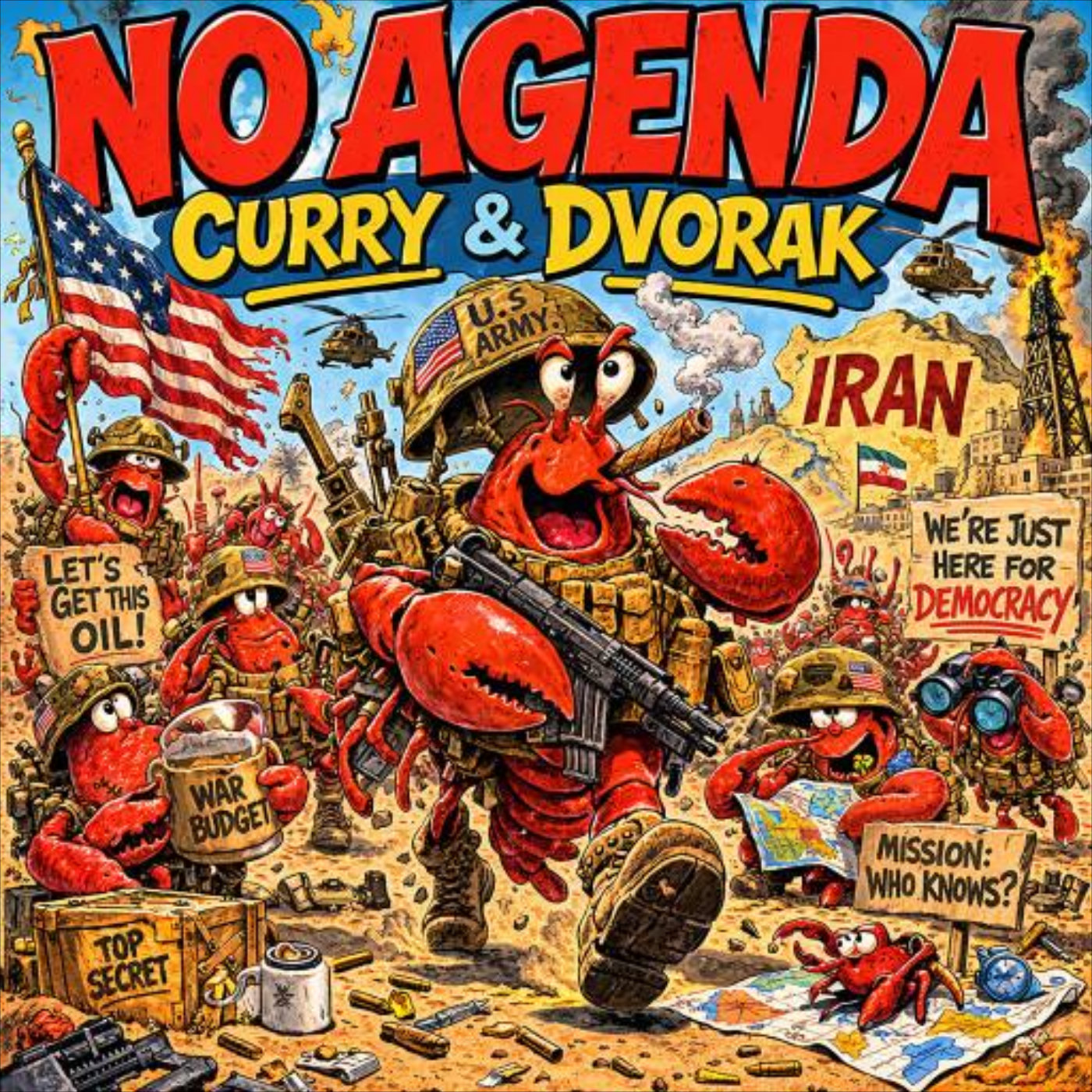
1851 - "Mork & Mimi" • Mar 15
- Adam Curry and Mimi Smith-Dvorak deconstructed war coverage, including a U.S. tanker crash in Iraq, rising oil prices, and the easing of Russian oil sanctions.
- The No Agenda Show highlighted a supercut of politicians and pundits repetitively using the phrase 'short-term pain for long-term gain' to justify the conflict's economic and human costs.
Also from this episode:
Media (6)
- A 1988 interview in which Donald Trump threatened to seize Iran's Karg Island, its primary oil export hub, has resurfaced in media coverage of the 2026 U.S.-Iran conflict.
- Fox News host Brian Kilmeade confronted Trump with the decades-old threat on air, a clip analyzed by the No Agenda Show.
- Trump dismissed Kilmeade's question as foolish, rhetorically asking what fool would answer whether he would still seize the island.
- Trump pivoted from the Iran question to boasting about his prescient 2000 call to kill Osama bin Laden, which he claims was ignored until after 9/11.
- The hosts critiqued media factual sloppiness with a segment on the misidentification of a historic California bar, the Hotsy Totsy Club.
- Co-host John C. Dvorak is recovering from heart surgery; Adam Curry reported Dvorak sounded unusually upbeat during a hospital call and is expected to be released soon.
Related Stories
POLITICS
Trump tests NATO loyalty with Iran war, sparks internal Democratic revolt
No Agenda Show · Breaking Points with Krystal and Saagar · All-In with Chamath, Jason, Sacks & Friedberg · The Daily · Breaking Points with Krystal and Saagar · Breaking Points with Krystal and Saagar · Pod Save America
POLITICS
Media in crisis: fraud, fear, and state control
Behind the Bastards · Moonshots with Peter Diamandis · Behind the Bastards · The Tucker Carlson Show · Breaking Points with Krystal and Saagar · Sean Carroll's Mindscape · Modern Wisdom
BUSINESS
Middle East energy war threatens global stagflation and Asia crisis
Breaking Points with Krystal and Saagar · The Intelligence from The Economist · Forward Guidance · The Intelligence from The Economist · The Intelligence from The Economist · Peter St Onge Podcast